
Incident Triage & Classification
Part of the Cybersecurity Roadmap
In short
Not every incident is a five alarm fire. Triage decides how serious this one is and how fast to react, so you spend your energy where it truly matters.
Quickly assessing an incident's scope and severity to prioritize response — not every incident needs the same urgency, and misclassifying severity wastes limited response capacity.
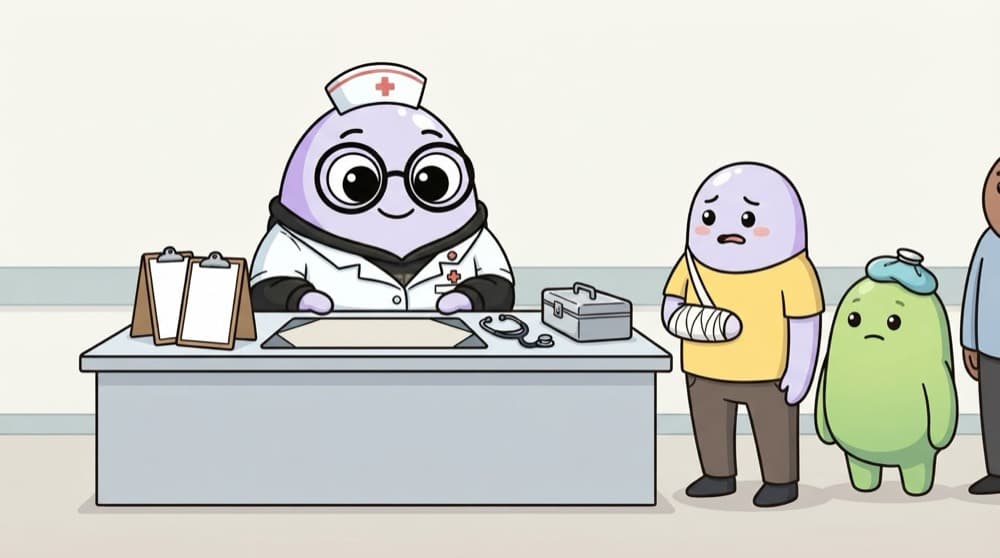
Think of it like this
Sorting patients at casualty
A casualty ward cannot treat everyone at once, so a nurse grades each arrival: critical, urgent or can wait. Getting that grade wrong wastes a doctor on a sprained ankle while a heart attack waits. Incident classification is the same careful grading.
Watch it happen
Grading an incident
1/4An incident is reported, by a tool, a user or another team.
The big ideas
What you need to know
Impact meets urgency
Severity blends how bad the damage could be with how fast it is spreading. Both drive the grade.
Use a fixed scale
Agree a low to critical scale in advance, so two analysts grade the same incident the same way.
Data sensitivity counts
The same malware on a test box and on a server holding customer data are not the same severity.
Grades can change
New facts may raise or lower the grade. Re-classify as the picture clears, do not lock it in too early.
Save yourself the pain
Common mistakes
Oops
Marking everything critical to be safe.
Do this instead
If all is critical, nothing is. Over grading burns out responders and hides the genuinely urgent cases.
Oops
Grading once and never revisiting it.
Do this instead
Early information is thin. Re-classify as scope becomes clear, up or down, so the response stays right sized.
Your mission
Build a severity matrix
Quick check
Two incidents involve the same malware. Why might they get different severities?
Go deeper
- 1Draft a simple severity classification scheme (e.g. low/medium/high/critical) with clear criteria.
- 2Practice classifying 3-5 hypothetical incident scenarios using your scheme.
- 3Learn why initial triage information is often incomplete, and classification may need to be revised.
More topics at this stop
 Incident Response Lifecycle
 Containment, Eradication & Recovery
 Digital Forensics Fundamentals
 Chain of Custody
 Memory & Disk Forensics Basics
 Malware Analysis Basics
 Post-Incident Reporting
 Tabletop Exercises

Stuck on this topic? Ask an Insider
Get 1:1 guidance from people who've walked this exact path — on the InsideEdge app.
