Digital Forensics Fundamentals
Part of the Cybersecurity Roadmap
In short
After an attack, the machine holds the story of what happened. Forensics is reading that story carefully, without smudging the very evidence you need.
The practice of collecting, preserving, and analyzing digital evidence in a way that maintains its integrity — essential both for incident investigation and, in some cases, for legal proceedings.
Think of it like this
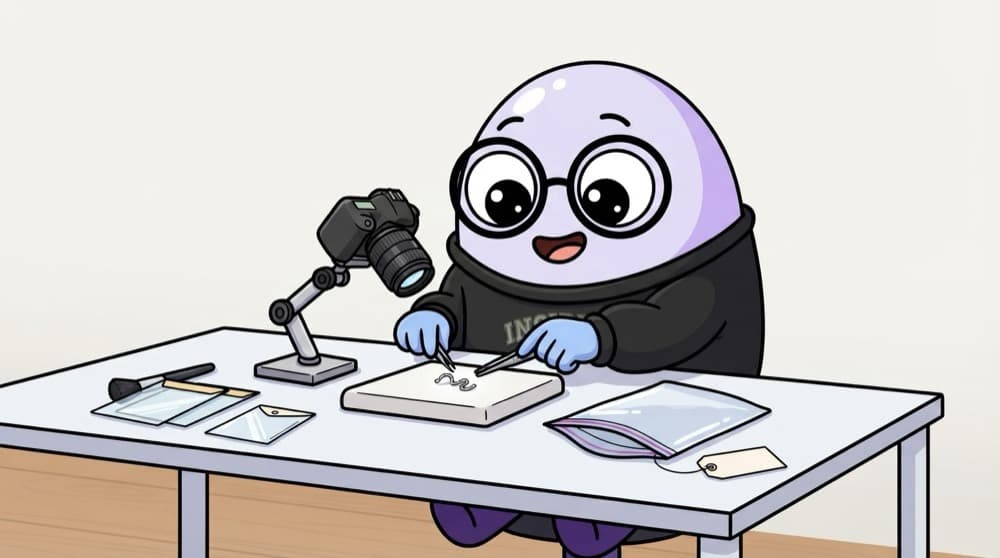
The careful crime scene officer
A good officer at a scene does not trample footprints or move the furniture. They photograph, label and bag each item before touching anything else. Digital forensics is that discipline for computers: preserve first, examine second, and never alter the original.
Watch it happen
The forensic process
1/4Protect the original. Do not keep using the machine; every action changes the evidence.
The big ideas
What you need to know
Preserve the original
Every click changes a disk. Work on a copy so the original stays pristine for later checks or court.
Hashes prove integrity
A hash of the image acts like a seal. If it still matches later, you can prove nothing was altered.
Work on the copy
Never investigate the live original. Analyse the verified image, so the evidence stays trustworthy.
Order of volatility
Some data vanishes fast, like memory, and some lasts, like disk. Capture the fragile things first.
See it in code
Walk through the code
1# On a lab machine YOU own: make a verified disk image2# Create a read-only, bit-for-bit copy of the evidence disk3dd if=/dev/sdb of=evidence.img bs=4M conv=noerror,sync status=progress4 5# Record a hash so you can prove the image never changed6sha256sum evidence.img > evidence.img.sha2567cat evidence.img.sha2561/3dd copies the whole disk block by block into an image file you then analyse instead of the original.
Only ever image a disk you own or are authorised to examine. The hash is your proof of integrity, checked again at every handover.
Save yourself the pain
Common mistakes
Oops
Investigating directly on the live, original machine.
Do this instead
That changes the evidence. Image the disk, verify the hash, and analyse the copy instead.
Oops
Forgetting to hash the image at capture time.
Do this instead
Without an early hash you cannot prove the data is unchanged. Hash at capture and re-check at every step.
Your mission
Image a USB you own
Quick check
Why do forensic analysts work on a copy rather than the original disk?
Go deeper
- 1Read a conceptual overview of the digital forensics process: identify, preserve, analyze, report.
- 2Learn why forensic soundness (not altering evidence) is critical even in a purely internal investigation.
- 3Understand the difference between live forensics (on a running system) and dead-box forensics (offline).
More topics at this stop
 Incident Response Lifecycle
 Incident Triage & Classification
 Containment, Eradication & Recovery
 Chain of Custody
 Memory & Disk Forensics Basics
 Malware Analysis Basics
 Post-Incident Reporting
 Tabletop Exercises

Stuck on this topic? Ask an Insider
Get 1:1 guidance from people who've walked this exact path — on the InsideEdge app.
