
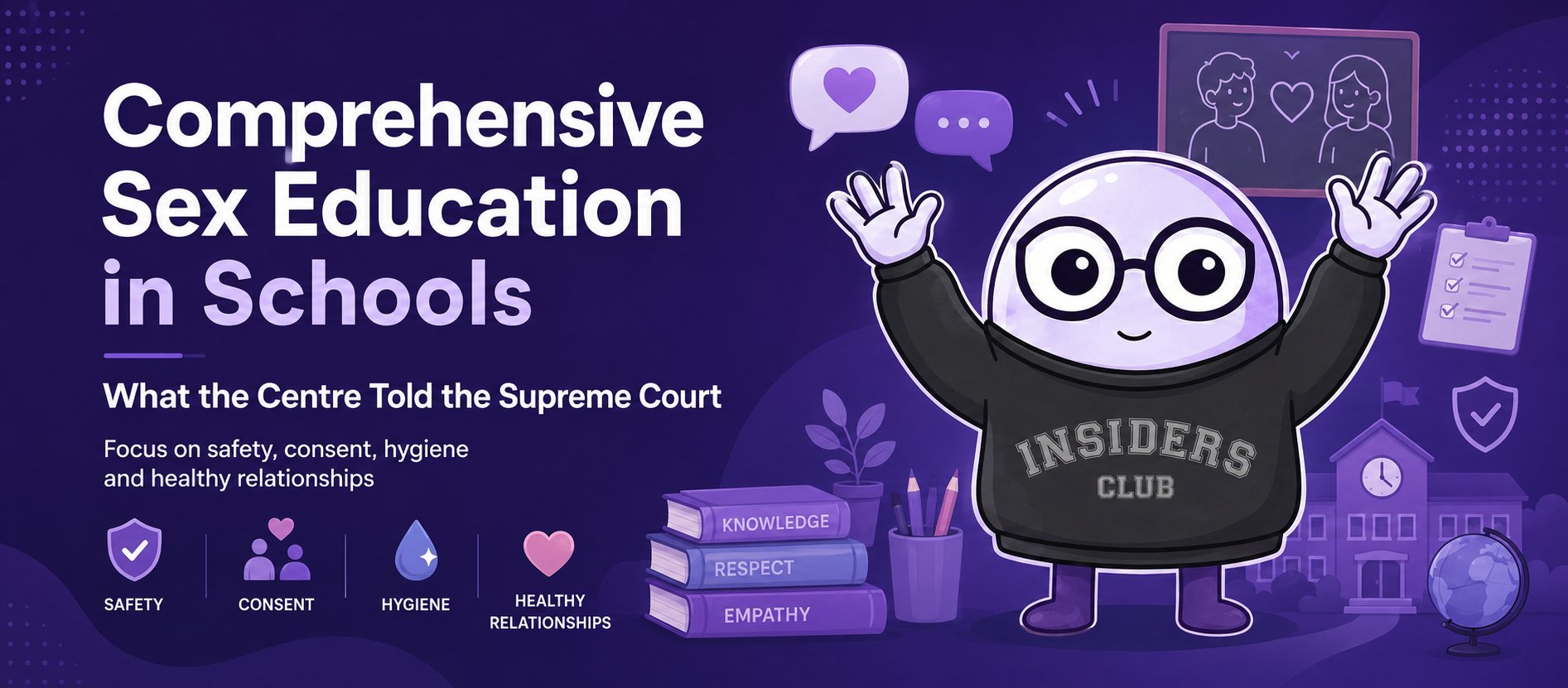
Comprehensive sex education could soon become part of school and college education across India.
The Central Government has informed the Supreme Court that it has accepted the recommendations of a national expert committee proposing structured and age-appropriate sex education for students. The programme is expected to be implemented nationwide after receiving the Court’s approval.
The proposal marks a potentially important shift in Indian education, where conversations around puberty, consent, personal boundaries and sexual health have traditionally been limited, inconsistent or avoided altogether.
What Has the Centre Proposed?
According to reports, the government told a Supreme Court bench comprising Justices B.V. Nagarathna and R. Mahadevan that it was agreeable to introducing comprehensive sex education in schools and colleges.
The recommendations were prepared by a 26-member national expert committee consisting of representatives from central ministries, state governments, the National Commission for Protection of Child Rights, clinical psychologists, legal experts and academics.
The programme is expected to focus on more than reproductive health. It may include:
Body safety and personal hygiene
Correct understanding of body parts
Safe and unsafe touch
Consent and personal boundaries
Healthy relationships
Puberty and adolescent development
Child sexual abuse awareness
Life skills and help-seeking behaviour
The content would reportedly be introduced gradually, based on the student’s age and developmental stage.
Sex Education Could Begin at the Primary Level
One of the most significant recommendations is that age-appropriate education should begin from the primary-school level rather than being introduced only in the higher classes.
For younger students, the focus would likely remain on body awareness, hygiene, personal safety and recognising inappropriate behaviour. Older students could gradually learn about puberty, emotional well-being, relationships, consent and sexual and reproductive health.
The expert committee has reportedly recommended that schools appoint dedicated, trained teachers to conduct mandatory sessions of around 15 to 20 minutes at least twice a week.
This would make the subject a regular and structured part of education instead of limiting it to occasional workshops.
NCERT May Develop a Common Curriculum
The committee has recommended that the National Council of Educational Research and Training develop the curriculum.
A centrally designed framework could help create greater consistency across schools and reduce the risk of students receiving incomplete, inaccurate or culturally insensitive information.
However, the final effectiveness of the programme would depend on how the curriculum is designed, how teachers are trained and how sensitively the lessons are delivered.
The content would need to be age-appropriate, scientifically accurate and focused on safety and well-being rather than fear or shame.
Why Is the Supreme Court Examining the Issue?
The recommendations emerged from proceedings concerning adolescent relationships, minor pregnancies and cases registered under the Protection of Children from Sexual Offences Act.
The Supreme Court had earlier considered the broader need for adolescent well-being and comprehensive sexuality education. In a May 2025 judgment, the Court recorded submissions highlighting gaps in India’s existing sexuality education policies, particularly the limited availability of structured programmes before the secondary-school level.
The Court was also informed that insufficient access to reliable information can contribute to misinformation, stigma, unsafe behaviour and poor awareness of sexual and reproductive health.
The expert committee was therefore asked to examine preventive and educational measures rather than relying only on criminal-law responses after an incident has already occurred.
The Role of Parents and Teachers
The proposal does not place the entire responsibility on students or schools.
The committee has also recommended regular meetings and awareness sessions for parents, guardians and teachers. These sessions would help adults understand children’s developmental stages and communicate about sensitive subjects more responsibly.
This involvement is important because even a strong school curriculum may fail when children receive contradictory, shame-based or misleading information at home.
Parents may also need guidance on:
Responding calmly to children’s questions
Teaching personal boundaries
Recognising behavioural warning signs
Discussing puberty without embarrassment
Helping children report uncomfortable or unsafe situations
Why Comprehensive Sex Education Matters
Comprehensive sex education is often misunderstood as teaching children about sexual activity. In reality, age-appropriate education can begin with basic lessons about safety, respect, hygiene and bodily autonomy.
For younger students, it can help them identify unsafe touch and seek help from a trusted adult.
For adolescents, it can provide reliable information about puberty, consent, relationships, online safety, reproductive health and the legal consequences of certain actions.
A well-designed curriculum may also reduce students’ dependence on social media, pornography, rumours or peer conversations as their main sources of information.
The objective is not simply to provide facts. It is also to help students develop judgment, confidence, communication skills and respect for themselves and others.
What Could Be the Main Challenges?
Introducing comprehensive sex education nationwide would not be easy.
Schools may face resistance from parents or communities that misunderstand the meaning of the programme. Teachers may feel uncomfortable or inadequately prepared to discuss sensitive subjects. There may also be differences in implementation across states, private schools and government institutions.
The programme would therefore require:
Specialised teacher training
Clear and age-appropriate teaching material
Confidential support systems for students
Parental orientation
Regular monitoring
Protection against moralistic or inaccurate teaching
Simply adding a chapter to a textbook would not be enough.
The success of the initiative would depend on whether students feel safe asking questions and whether teachers are equipped to answer them without judgment.
Alignment With the National Education Policy
The expert panel has recommended that adolescent education be implemented in line with the National Education Policy 2020.
The broader focus would be on holistic development, critical thinking, health awareness, safety and life skills. Existing adolescent education programmes may also be reviewed and strengthened.
The recommendations further suggest integrating awareness of the POCSO Act into educational modules so that students understand child-protection laws, personal boundaries and the importance of reporting abuse.
What Happens Next?
The Centre has accepted the committee’s recommendations, but the proposal is still awaiting the Supreme Court’s approval.
This means comprehensive sex education has not yet been formally introduced in every school or college. The final structure, timeline and implementation guidelines will become clearer only after further orders and official government notifications.
Until then, schools, parents and students should avoid treating the reported recommendations as a fully implemented national policy.
Final Word
The proposed introduction of comprehensive sex education could become a major development in India’s education system.
When taught responsibly, it can help children understand their bodies, identify unsafe situations, respect personal boundaries and access reliable information during adolescence.
The larger challenge will be ensuring that the programme is not reduced to a symbolic chapter or occasional lecture. It must be supported by trained teachers, informed parents, safe counselling systems and a curriculum designed around dignity, health and child protection.
The Centre’s submission before the Supreme Court is an important step. Its real impact, however, will depend on how effectively and sensitively the recommendations are converted into classroom practice.