
In short
You change one function at midnight before a deadline. How do you know you didn't break three others? Unit tests check each small piece on its own, in milliseconds.
Testing the smallest independent pieces of backend code — a single function or class — in isolation from the database, network, or other dependencies.
Think of it like this
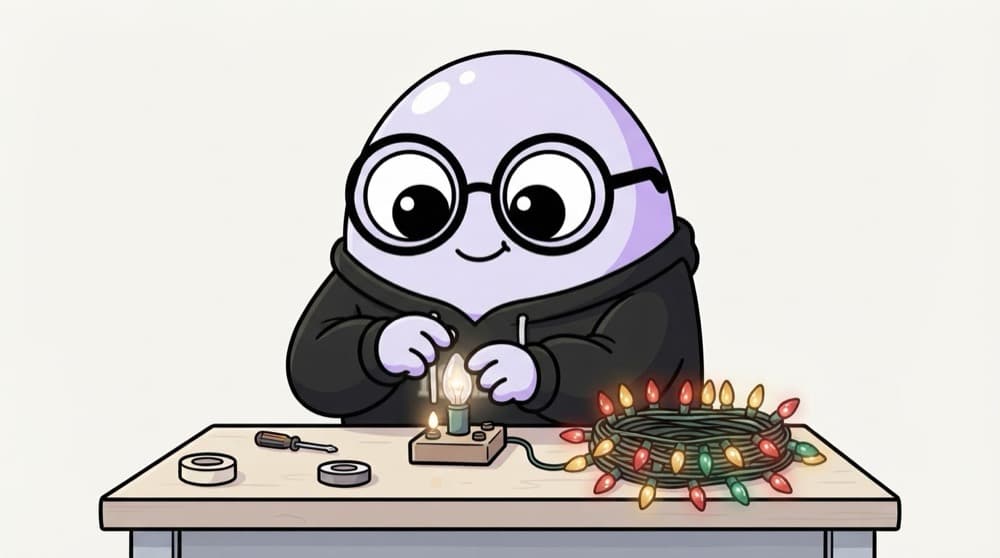
Testing each bulb first
Before stringing up Diwali lights, you test each bulb in a small tester. If the whole string fails later, you already know the bulbs are fine and the fault is elsewhere. A unit test checks one function by itself, with no database or network involved.
Watch it happen
Arrange, Act, Assert
1/6Arrange: build a cart with items worth 300 and 200 rupees, and a 10% coupon.
The big ideas
What you need to know
One behaviour per test
Each test checks one thing, like 'expired coupons are ignored'. When it fails, the name tells you what broke.
Fast and isolated
No database, files or network. Hundreds of unit tests should finish in seconds.
Pure functions are easiest
Functions that take inputs and return outputs, with no side effects, are a joy to test. Design for that.
Test the edges
Empty carts, zero, negative numbers, huge values. Bugs love the edges.
See it in code
Walk through the code
1import { test } from "node:test";2import assert from "node:assert/strict";3import { calculateTotal } from "./cart.js";4 5test("applies a 10% coupon", () => {6 const cart = [{ price: 300 }, { price: 200 }];7 const total = calculateTotal(cart, { percentOff: 10, expired: false });8 assert.equal(total, 450);9});10 11test("ignores an expired coupon", () => {12 const cart = [{ price: 300 }, { price: 200 }];13 assert.equal(calculateTotal(cart, { percentOff: 10, expired: true }), 500);14});1/3Node's built-in test runner and strict assertions. No extra packages needed.
Run it with node --test. The same Arrange, Act, Assert shape works in Jest, Vitest or Mocha.
Save yourself the pain
Common mistakes
Oops
Testing private helper details, so every refactor breaks the tests.
Do this instead
Test what the function promises: inputs and outputs. Then you can rewrite its insides freely.
Oops
One giant test that checks ten different things.
Do this instead
Split it. Small, well-named tests tell you exactly what broke without reading the code.
Your mission
Test a pure function
Quick check
Which of these is a unit test?
Go deeper
- 1Write unit tests for 3-4 pure utility functions in a backend project.
- 2Practice testing edge cases (empty input, invalid data), not just the happy path.
- 3Learn the AAA pattern: Arrange, Act, Assert.
More topics at this stop
 Integration Testing
 Jest
 Mocha & Chai
 Supertest
 Mocking & Stubbing
 Test Coverage
 TDD Basics
 API Testing with Postman/Newman

Stuck on this topic? Ask an Insider
Get 1:1 guidance from people who've walked this exact path — on the InsideEdge app.
