
Process Modeling Questions
Part of the Business Analyst Roadmap
In short
'Walk me through how you'd document this process' or 'What's BPMN?' Interviewers want to see you can turn messy reality into a clear diagram, and that you've actually used a tool to do it.
'How would you document this process?' or 'walk me through BPMN' — testing Phase 4's process modeling fluency, including hands-on tool experience.
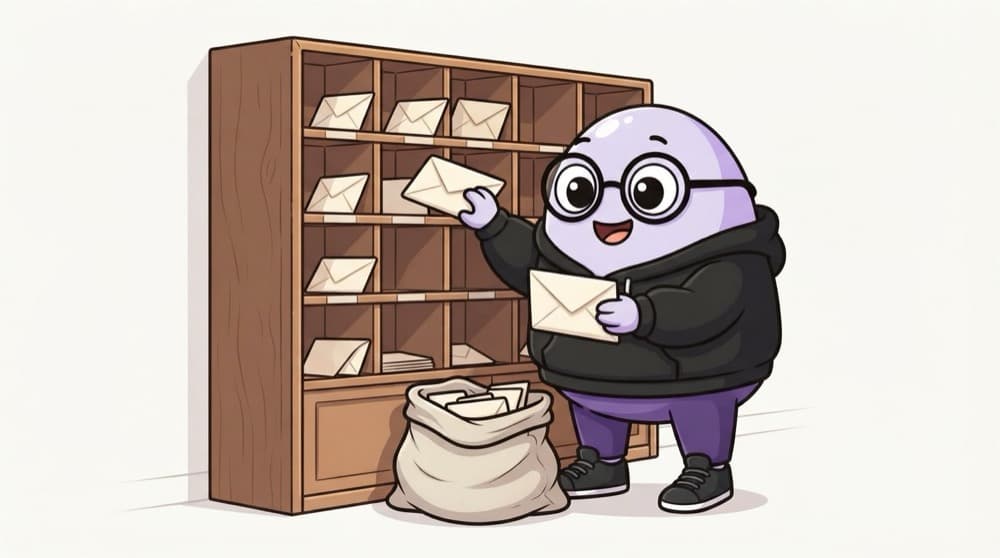
Think of it like this
The post office sorting room
A letter arrives, gets stamped, sorted by PIN code into a pigeonhole, bagged and sent on. Each person does one part, in order, with a rule for odd cases like a missing address. Explain any process like that sorting room.
Watch it happen
How to talk through modelling a process
1/5Define start and end: 'From customer raising a return to refund received.'
The big ideas
What you need to know
BPMN basics
Events are circles, tasks are rounded rectangles, gateways are diamonds, and lanes show who does what.
As-Is vs To-Be
Explain that you map the current process first, then design the improved one. Never skip the current state.
Exceptions matter
Interviewers love hearing 'and here's where it goes wrong'. Mention rework loops and escalations.
Name your tools
Say what you've used, like Visio, Lucidchart or draw.io, and show a diagram from your portfolio if you can.
How it works
If they ask you to draw on a whiteboard
- 1
Ask the scope
Confirm where the process starts and ends before drawing anything.
- 2
Draw lanes first
Lanes for each role make the rest easy to place.
- 3
Talk while drawing
Narrate each step so the interviewer follows your thinking.
- 4
Point out a problem
End by circling one delay or handoff you'd improve.
Save yourself the pain
Common mistakes
Oops
Describing only the perfect flow.
Do this instead
Show at least one decision and one exception. Real processes are messy.
Oops
Using shapes inconsistently on a whiteboard.
Do this instead
Stick to a few standard shapes and say what each means as you draw.
Your mission
Model a return process
Quick check
In BPMN, what shows a point where the process splits based on a condition?
Go deeper
- 1Review Phase 4 and practice sketching a simple process diagram from memory.
- 2Prepare to explain the difference between As-Is and To-Be mapping.
- 3Practice describing a real or hypothetical process improvement you identified.
More process & analysis at this stop
 Gap Analysis Scenarios
 Data Analysis Questions

Stuck on this topic? Ask an Insider
Get 1:1 guidance from people who've walked this exact path — on the InsideEdge app.
