Communicating Failed Models
Part of the Data Science Roadmap
In short
'Tell me about a model that didn't work.' Everyone has one. The interviewer isn't judging the failure. They're judging whether you spotted it, owned it and changed how you work.
'Tell me about a model that didn't work' — testing self-awareness and whether you actually learn from mistakes, not just how you handle success.
Think of it like this
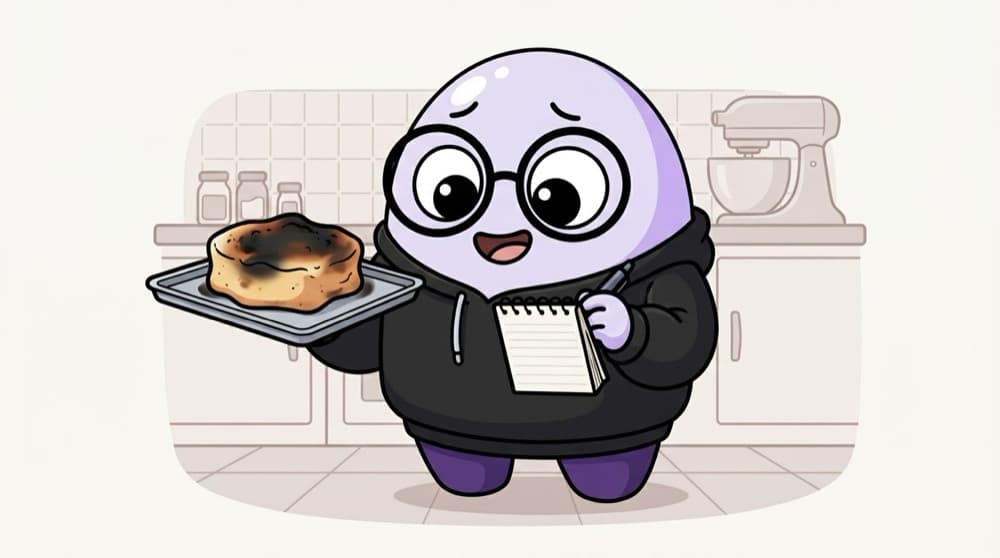
The burnt birthday cake
You baked a cake for Amma's birthday and the bottom burnt. You could hide it. Or you could say: the oven was too hot, I didn't check at 30 minutes, next time I'll lower the rack and set a timer. The second answer makes people trust your next cake.
Watch it happen
Answer structure for a failure story
1/5Name a real failure with stakes: 'My demand model looked great offline but was badly off in its first week live.'
The big ideas
What you need to know
Pick a real failure
A genuine mistake with consequences. Fake ones like 'I work too hard' lose trust fast.
Own your part
Say what you got wrong. Mention others only to show how you worked with them.
Show you told people early
Flagging a problem quickly is a strength. Hiding it is the real failure.
End with a lasting change
A new habit or checklist shows the lesson stuck.
Save yourself the pain
Common mistakes
Oops
Choosing a 'failure' that's secretly a success story.
Do this instead
Pick something that actually went wrong. Interviewers can tell, and real ones are more convincing.
Oops
Blaming the data, the deadline or a teammate.
Do this instead
Acknowledge the constraints briefly, then focus on what you could control and what you changed.
Your mission
Write your failure story
Quick check
Which ending makes a failure story strongest?
Go deeper
- 1Prepare a genuine failure story, not a humble-brag disguised as one.
- 2Focus more time on what you learned and changed than on the failure itself.
- 3Practice owning your part in it directly, without deflecting blame to the data or stakeholders.
More behavioral at this stop
 Explain a Past ML Project
 Handling Ambiguous Problems
 Cross-Functional Collaboration Stories

Stuck on this topic? Ask an Insider
Get 1:1 guidance from people who've walked this exact path — on the InsideEdge app.
