In short
Data is full of chance: who clicks, who pays late, which delivery is delayed. Probability gives you a clear way to talk about 'how likely' instead of guessing.
The mathematical language for reasoning about uncertainty — combining probabilities, conditional probability, and Bayes' theorem — foundational for everything from Naive Bayes to model confidence.
Think of it like this
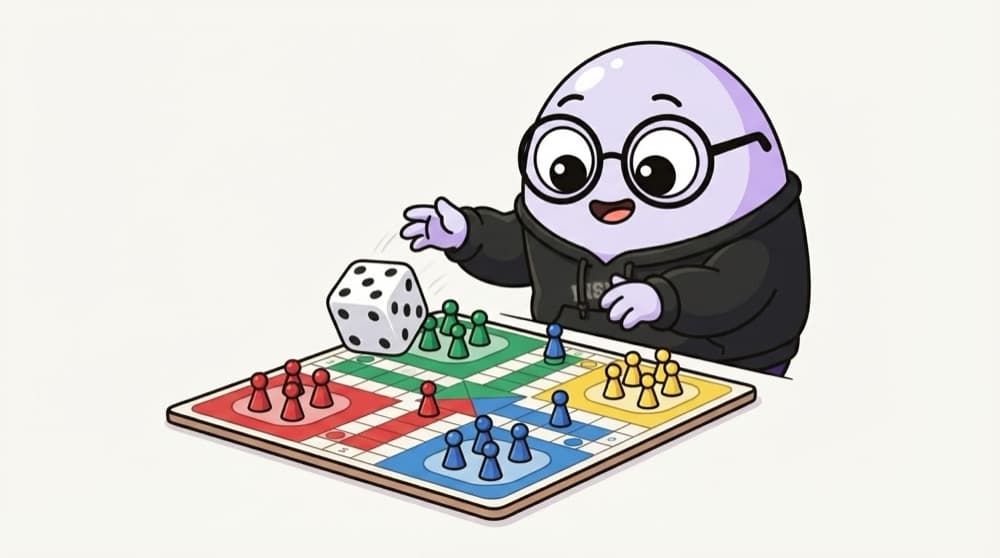
A game of Ludo
Everyone at home knows you need a six to start in Ludo, and that it feels rare. Probability puts a number on that feeling: 1 out of 6 faces. It also tells you how rare two sixes in a row are.
Watch it happen
One dice, a few events
1/5Six equally likely outcomes. Each has probability 1/6.
The big ideas
What you need to know
Between 0 and 1
0 means impossible, 1 means certain. All outcomes together add up to exactly 1.
Independent events multiply
If one doesn't affect the other, P(A and B) = P(A) × P(B).
Conditional probability
P(A | B) is the chance of A once you know B happened. It's how you update with new information.
Long-run frequency
Roll enough times and the share of sixes settles near 1/6. Simulations use this idea.
See it in code
Walk through the code
1import numpy as np2 3rng = np.random.default_rng(42)4rolls = rng.integers(1, 7, size=100_000)5 6print((rolls == 6).mean()) # close to 1/6 = 0.1677print((rolls % 2 == 0).mean()) # close to 0.58 9two = rng.integers(1, 7, size=(100_000, 2))10print((two == 6).all(axis=1).mean()) # close to 1/36 = 0.0281/3Roll a fair dice 100,000 times. The upper limit 7 is excluded, so values are 1 to 6.
When maths gets tricky, simulate. A lakh of fake dice rolls lands very close to the exact answers.
Save yourself the pain
Common mistakes
Oops
Believing a six is 'due' after many rolls without one.
Do this instead
Dice have no memory. Each roll is still 1/6. This is the gambler's fallacy.
Oops
Adding probabilities of events that can happen together.
Do this instead
Add only for events that can't both happen. Otherwise subtract the overlap: P(A) + P(B) − P(A and B).
Your mission
Simulate a birthday surprise
Quick check
A coin lands heads five times in a row. What's the chance the next flip is heads?
Go deeper
- 1Work through basic probability problems (dice, cards, simple events).
- 2Learn conditional probability with a concrete, worked example.
- 3Study Bayes' theorem and one classic application (e.g. medical testing false positives).
More topics at this stop
 Linear Algebra Essentials (Vectors, Matrices)
 Calculus Essentials (Derivatives, Gradients)
 Descriptive & Inferential Statistics
 Hypothesis Testing
 Distributions (Normal, Binomial, Poisson)
 Bayesian Thinking Basics
 Linear Regression Math
 Optimization Basics (Gradient Descent)

Stuck on this topic? Ask an Insider
Get 1:1 guidance from people who've walked this exact path — on the InsideEdge app.
