Incident Response Questions
Part of the DevOps Roadmap
In short
'Walk me through your incident process' checks whether you know who does what when things break: who leads, who fixes, who talks to customers. Calm structure is the answer they want.
'Tell me about handling a production incident' or 'walk me through your postmortem process' — connecting Phase 11 and Phase 13's incident response and blameless culture concepts.
Think of it like this
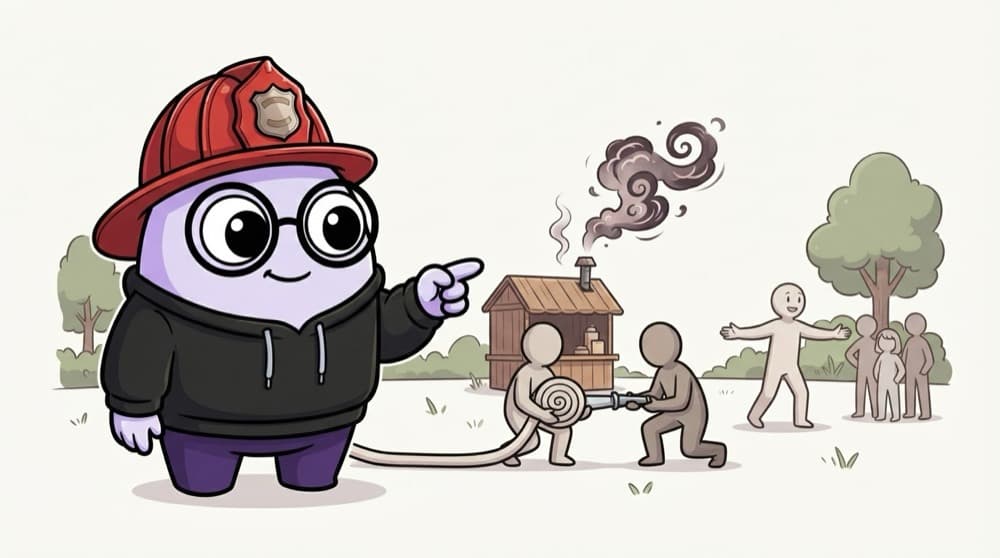
The fire brigade crew
At a fire, one officer gives orders, two firefighters handle the hose and one keeps the crowd back. Nobody argues about who's in charge mid-fire. Software incidents work best the same way, with clear roles from the first minute.
Watch it happen
Roles during a major incident
1/6Someone declares an incident and sets severity. The incident lead coordinates and doesn't type fixes.
The big ideas
What you need to know
Incident commander
One person leads and makes decisions. They delegate the hands-on work so they can see the whole picture.
Severity levels
SEV-1 for major user impact, lower levels for smaller issues. Severity decides who is paged and how fast.
Mitigate, then fix
Stop the bleeding with rollback, failover or a feature flag. The permanent fix can come later.
Close the loop
Every major incident ends with a blameless postmortem and action items that get tracked.
How it works
Answering 'walk me through your process'
- 1
Detect and declare
Alert fires or a report comes in. Declare an incident, set severity, open a channel.
- 2
Assign roles
Incident lead, people investigating, and someone handling communication.
- 3
Mitigate
Restore service fast with rollback or failover, with regular updates to stakeholders.
- 4
Learn
Postmortem within a few days, with owned actions to prevent a repeat.
Save yourself the pain
Common mistakes
Oops
Describing everyone jumping in to fix things at once with no leader.
Do this instead
Mention a single incident lead and clear task assignment. It shows you've thought about coordination, not just debugging.
Oops
Forgetting communication entirely.
Do this instead
Say how and how often you'd update stakeholders and customers. Silence during an outage damages trust.
Your mission
Write your incident one-pager
Quick check
During a major incident, what is the incident commander's main job?
Go deeper
- 1Review Phase 13's postmortem structure and practice explaining it clearly.
- 2Prepare a real incident story if you have one, even from a personal project gone wrong.
- 3Practice emphasizing systemic fixes and learning, not blame, in your answer.
More incident & reliability at this stop
 Troubleshooting Scenarios
 Monitoring & Alerting Questions

Stuck on this topic? Ask an Insider
Get 1:1 guidance from people who've walked this exact path — on the InsideEdge app.
