Dynamic Programming
Part of the Full Stack Developer Roadmap
In short
Dynamic programming has a scary name for a simple habit: never solve the same small problem twice. Write the answer down, reuse it, and slow recursion becomes fast.
Solving complex problems by breaking them into overlapping subproblems, solving each once, and reusing the cached results — arguably the hardest, most feared interview topic.
Think of it like this
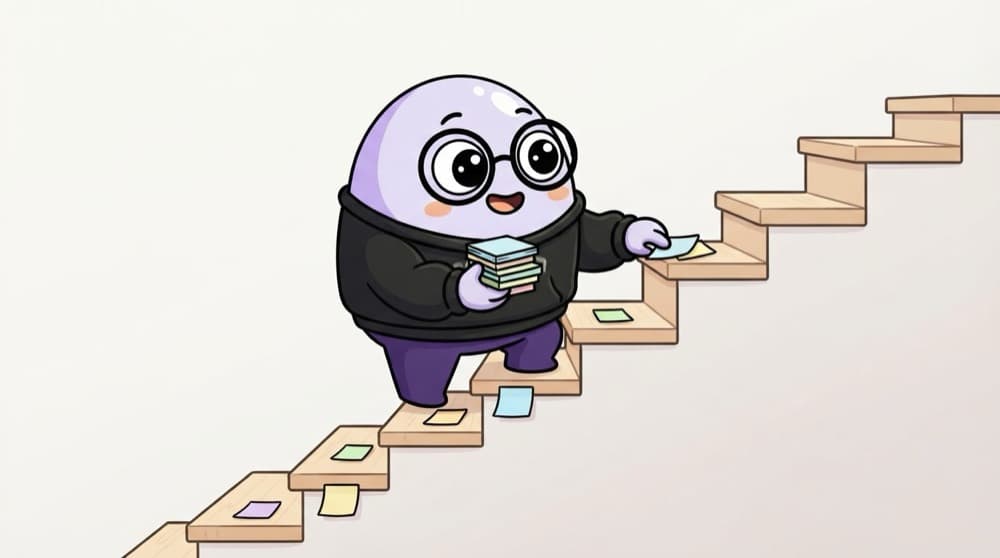
Sticky notes on the staircase
How many ways can you climb to step 5, taking 1 or 2 steps at a time? Work out step 1, stick a note on it. Step 2, another note. Each new step just adds the notes on the two steps below.
Watch it happen
Filling the table for climbStairs(5)
1/5dp[i] = ways to reach step i. Step 0 and step 1 each have exactly 1 way.
The big ideas
What you need to know
Overlapping subproblems
If plain recursion keeps calling the same inputs again, like fib(3) many times, DP can help.
Optimal substructure
The best answer for n can be built from best answers for smaller inputs.
Top-down: memoise
Keep your recursion and cache results in a Map. Easiest to write from a brute-force solution.
Bottom-up: fill a table
Start from the smallest cases and fill an array upward. No recursion, no stack limits.
See it in code
Walk through the code
1// Ways to climb n steps taking 1 or 2 at a time2function climbStairs(n: number): number {3 const dp = new Array(n + 1).fill(0);4 dp[0] = 1; // one way to stay at the bottom5 dp[1] = 1;6 for (let i = 2; i <= n; i++) {7 dp[i] = dp[i - 1] + dp[i - 2]; // last move was 1 step or 2 steps8 }9 return dp[n];10}11 12console.log(climbStairs(5)); // 81/3Make the table and fill in the base cases you know for sure.
Plain recursion here is O(2ⁿ). The table makes it O(n). You only ever need the last two values, so it can even be O(1) space.
Save yourself the pain
Common mistakes
Oops
Jumping straight to the table without knowing what dp[i] means.
Do this instead
Write one sentence first, like "dp[i] is the number of ways to reach step i". The code follows from it.
Oops
Getting base cases wrong, so every later cell is off.
Do this instead
Check dp[0] and dp[1] by hand on a tiny input before running anything.
Your mission
From recursion to DP
Quick check
When is dynamic programming most likely to help?
Go deeper
- 1Start with classic DP problems: climbing stairs, coin change, longest common subsequence.
- 2Practice both memoization (top-down) and tabulation (bottom-up) for the same problem.
- 3Learn to first write the brute-force recursive solution, then optimize with a cache.
More topics at this stop
 Arrays
 Strings
 Linked List
 Stack
 Queue
 HashMap
 Heap
 Tree
 Graph
 Binary Search
 Recursion
 Backtracking
 Sliding Window
 Greedy
 Sorting
 Searching

Stuck on this topic? Ask an Insider
Get 1:1 guidance from people who've walked this exact path — on the InsideEdge app.
