REST API Server
Part of the Full Stack Developer Roadmap
In short
Your first real backend: a REST API with a few resources that any frontend can call. No database yet, just clean routes, proper status codes and JSON you'd be proud to show in an interview.
A standalone REST API with a handful of resources — practice for routing, middleware and response design, built before wiring it up to a database in the next phase.
Think of it like this
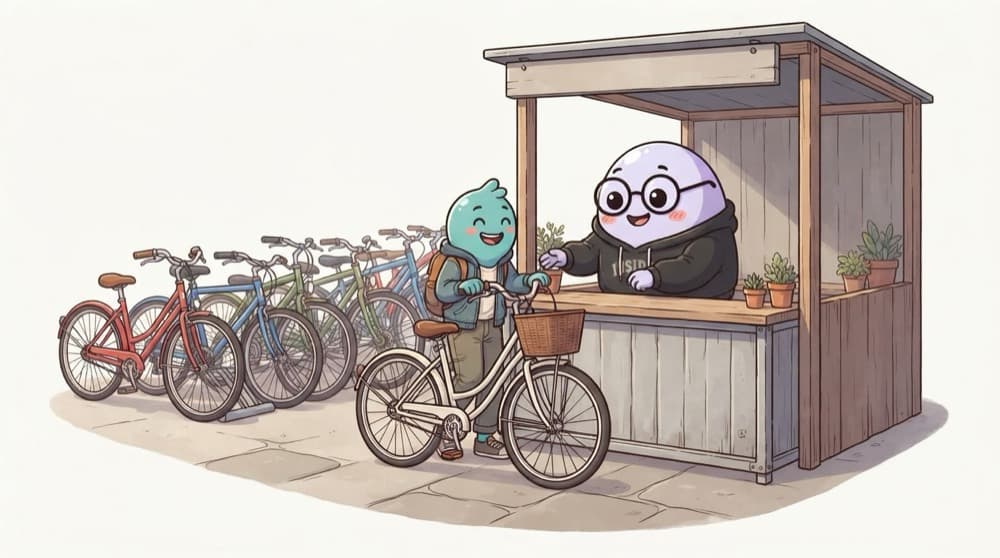
Running a cycle rental stand
Your stand has cycles. People ask to see all cycles, check one, add a new one to the fleet or retire a broken one. Each request is a clear action on one kind of thing. A REST API is the same: resources, plus a fixed set of actions on them.
Watch it happen
Build plan
1/6Write the routes on paper first: GET, POST, PATCH, DELETE for /api/cycles and /api/rentals.
The big ideas
What you need to know
Nouns in URLs, verbs in methods
Use /api/cycles with POST, not /api/createCycle. The method already says what you're doing.
Honest status codes
201 for created, 204 for deleted, 400 for bad input, 404 for missing. Your frontend will branch on these.
Same error shape everywhere
Always reply { error: "..." } on failure. The React side can then show errors with one helper.
Allow your frontend with CORS
A React app on port 5173 calling port 4000 needs CORS enabled for that origin, or the browser blocks it.
See it in code
Walk through the code
1import { Router } from "express";2const router = Router();3let cycles = [{ id: 1, model: "Blue 26-inch", rented: false }];4 5router.get("/", (req, res) => res.json(cycles));6router.get("/:id", (req, res) => {7 const cycle = cycles.find((c) => c.id === Number(req.params.id));8 cycle ? res.json(cycle) : res.status(404).json({ error: "Cycle not found" });9});10router.post("/", (req, res) => {11 const cycle = { id: Date.now(), model: req.body.model, rented: false };12 cycles.push(cycle);13 res.status(201).location(`/api/cycles/${cycle.id}`).json(cycle);14});15router.delete("/:id", (req, res) => { cycles = cycles.filter((c) => c.id !== Number(req.params.id)); res.status(204).end(); });16export default router; // in app.js: app.use("/api/cycles", router)1/4A Router for one resource, with an in-memory array standing in for the database.
One resource, four actions. Copy this shape for rentals and you have a working API.
Save yourself the pain
Common mistakes
Oops
Returning 200 with { success: false } when something fails.
Do this instead
Use the real status code. fetch, logs and monitoring tools all read the status, not your JSON flag.
Oops
Letting a thrown error send Express's default HTML error page to your React app.
Do this instead
Add one error-handling middleware at the end that logs the error and returns JSON with status 500.
Your mission
First milestone: cycles resource
Quick check
A client sends DELETE /api/cycles/5 and it succeeds. What's the cleanest response?
Go deeper
- 1Design and implement at least 2 resources with full CRUD routes.
- 2Use consistent status codes and response shapes across every endpoint.
- 3Test every endpoint with Postman before connecting a frontend to it.
More projects at this stop
 CRUD API with Validation

Stuck on this topic? Ask an Insider
Get 1:1 guidance from people who've walked this exact path — on the InsideEdge app.
