
Tree Pruning & Depth Control
Part of the Machine Learning Roadmap
In short
Left alone, a decision tree keeps asking questions until every leaf holds a single training example. It gets 100% on training data and stumbles on anything new. Pruning is how you stop it memorising.
An unrestricted tree keeps splitting until it memorises the training data. Limits like max_depth, min_samples_leaf and cost-complexity pruning (ccp_alpha) keep trees simpler so they generalise better.
Think of it like this
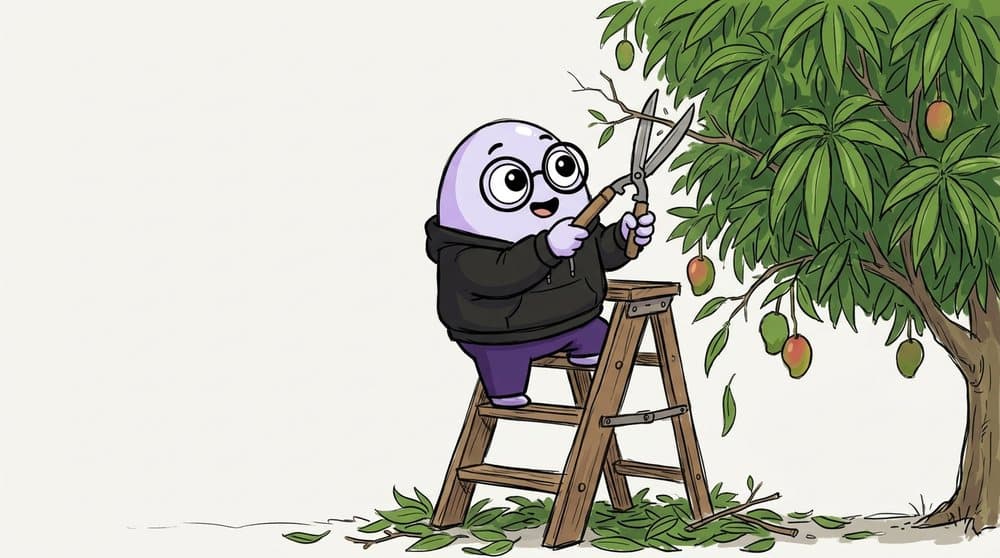
The gardener's shears
A mango tree left to grow wild sprouts hundreds of thin branches that carry tiny, weak fruit. The mali cuts back the extra branches so the tree's strength goes into a few strong ones. Limiting depth is deciding up front how tall it may grow. Cost-complexity pruning is growing it fully, then snipping branches that add little.
Watch it happen
Pruning a loan approval tree
1/4The first split on income separates most good and risky applicants.
The big ideas
What you need to know
max_depth
The simplest brake: no path longer than this many questions. Values of 3 to 10 are common starting points.
min_samples_leaf
Every leaf must hold at least this many training rows, so no rule is built on just one or two examples.
ccp_alpha
Cost-complexity pruning grows the full tree, then removes branches whose accuracy gain is not worth their size.
Tune with validation
Plot training and validation score against depth or alpha. Pick the point where validation peaks.
See it in code
Walk through the code
1import numpy as np2from sklearn.datasets import load_breast_cancer3from sklearn.model_selection import cross_val_score, train_test_split4from sklearn.tree import DecisionTreeClassifier5 6X, y = load_breast_cancer(return_X_y=True)7X_tr, X_te, y_tr, y_te = train_test_split(X, y, stratify=y, random_state=0)8 9full = DecisionTreeClassifier(random_state=0).fit(X_tr, y_tr)10print("depth", full.get_depth(), "train", full.score(X_tr, y_tr), "test", round(full.score(X_te, y_te), 3))11 12path = full.cost_complexity_pruning_path(X_tr, y_tr)13alphas = path.ccp_alphas[:-1] # last alpha prunes to a single node14 15scores = [cross_val_score(DecisionTreeClassifier(random_state=0, ccp_alpha=a), X_tr, y_tr, cv=5).mean()16 for a in alphas]17best_alpha = alphas[int(np.argmax(scores))]18 19pruned = DecisionTreeClassifier(random_state=0, ccp_alpha=best_alpha).fit(X_tr, y_tr)20print("depth", pruned.get_depth(), "test", round(pruned.score(X_te, y_te), 3))1/4The unpruned tree hits 100% on training data. Note its depth and test score.
Grow a full tree, get the list of useful alphas, and let cross-validation pick how hard to prune.
Save yourself the pain
Common mistakes
Oops
Judging a tree by its training accuracy.
Do this instead
An unpruned tree almost always reaches 100% on training data. Only validation or test scores tell you anything.
Oops
Choosing max_depth by trying values on the test set.
Do this instead
Use cross-validation on training data. Touch the test set once at the very end.
Your mission
Depth vs score
Quick check
A tree has 100% training accuracy and 82% test accuracy. Which change is most likely to help?
Go deeper
- 1Plot training and validation accuracy as max_depth goes from 1 to 20.
- 2Use cost_complexity_pruning_path to find a good ccp_alpha.
- 3Compare the size of the pruned and unpruned trees.
More topics at this stop
 Decision Trees: Gini & Entropy
 Bagging & Random Forests
 Boosting Explained (AdaBoost)
 Gradient Boosting Machines
 XGBoost, LightGBM & CatBoost
 Stacking & Voting Ensembles
 Feature Importance & Permutation Importance

Stuck on this topic? Ask an Insider
Get 1:1 guidance from people who've walked this exact path — on the InsideEdge app.
