Explaining Your Code Out Loud
Part of the Python Roadmap
In short
In a live interview, a candidate who talks clearly through a good approach often beats one who silently types a perfect answer. Interviewers are judging how you'd work with them on a real team.
In live interviews, how you talk through a problem matters as much as the final code. Restate the problem, discuss a brute-force idea, improve it, then code while explaining and finish by testing with an example.
Think of it like this
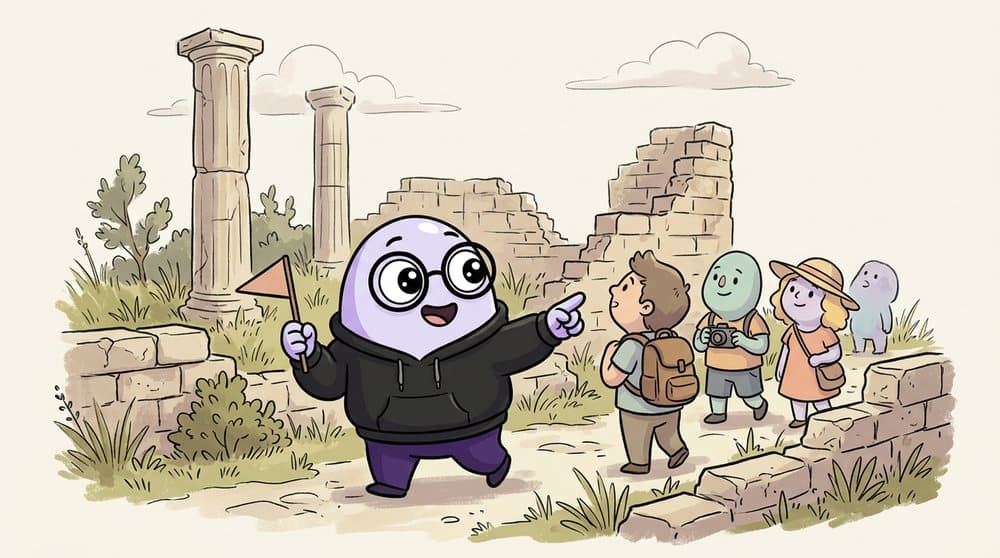
A tour guide at Hampi
A good guide doesn't walk silently to the next temple. They say where you're heading, why it matters and what to look at when you arrive. If someone asks a question, they pause and answer. Explaining code is guiding the interviewer through your thinking so they never feel lost.
Watch it happen
A good first five minutes
Find two numbers that add up to target
1/5Don't start typing yet.
The big ideas
What you need to know
Restate the problem
Say it back in your own words with a small example. It catches misunderstandings in the first minute.
Brute force, then better
Name the simple approach and its complexity, then improve it. It shows a clear path of thought.
Narrate while coding
Say what each block does as you write it. Silence for minutes makes the interviewer guess.
Test out loud
Walk one example through your code line by line, then mention edge cases like empty input.
How it works
A talk track for any coding question
- 1
Restate
Repeat the problem and run through one example by hand.
- 2
Clarify
Ask about input size, duplicates, negatives and empty input.
- 3
Approach
Describe brute force, then a better idea, with time and space complexity.
- 4
Code
Write clean code while explaining each part.
- 5
Test
Trace an example, then edge cases, and fix bugs calmly.
See it in code
Walk through the code
1def two_sum(nums: list[int], target: int) -> list[int]:2 # "I'll store each number's index in a dict as I go."3 seen: dict[int, int] = {}4 for i, x in enumerate(nums):5 # "For each number, the partner I need is target - x."6 need = target - x7 if need in seen:8 # "If I've already seen it, I have my pair."9 return [seen[need], i]10 # "Otherwise remember this number for later ones."11 seen[x] = i12 # "If no pair exists, I'll return an empty list. Is that okay?"13 return []14 15# "Let me test with nums = [2, 7, 11, 15], target = 9:16# i=0, x=2, need 7, not seen, store 2 -> 017# i=1, x=7, need 2, seen at 0, return [0, 1]."18print(two_sum([2, 7, 11, 15], 9)) # [0, 1]1/4Announce the data structure and why before writing it.
The comments show what you'd say out loud. In a real interview you speak them instead of typing them all.
Save yourself the pain
Common mistakes
Oops
Typing silently for ten minutes, then explaining at the end.
Do this instead
Talk as you go. If you're heading the wrong way, the interviewer can nudge you early.
Oops
Freezing when you spot a bug.
Do this instead
Say "I see a bug here, let me fix it". Finding and fixing your own bug calmly is a positive signal.
Oops
Ignoring the interviewer's hints.
Do this instead
Hints are help, not criticism. Pause, consider them out loud and adjust your approach.
Your mission
Record a mock round
Quick check
What is usually the best first step after hearing a coding question?
Go deeper
- 1Record yourself solving one problem while talking, then watch it back.
- 2Practise saying the time and space complexity before you are asked.
- 3Do mock interviews with a friend and swap roles.
More topics at this stop
 Building a Python Portfolio on GitHub
 Writing Good READMEs
 Core Python Interview Questions
 Python Coding Questions
 Coding Rounds on LeetCode & HackerRank
 Resume for Python Roles
 Contributing to Open Source
 What to Learn After Python

Stuck on this topic? Ask an Insider
Get 1:1 guidance from people who've walked this exact path — on the InsideEdge app.
