
In short
Raw data says amount = 2,450. Your manager wants "high", "medium" or "low". CASE WHEN is SQL's if-else, turning values into labels, buckets and flags inside any query.
CASE WHEN is SQL's if-else. It returns different values based on conditions, which lets you bucket, label or flag rows inside a query.
Think of it like this
Marks into grades
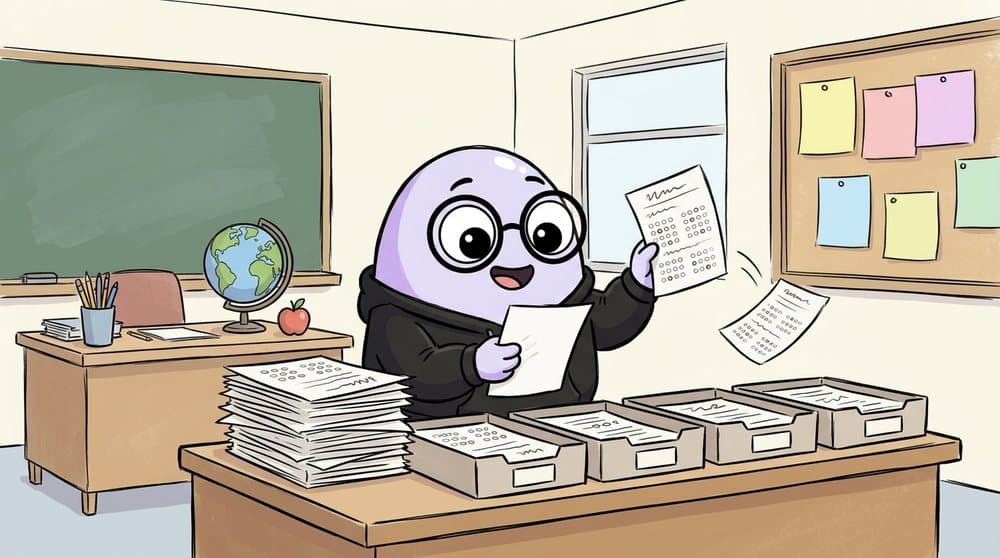
A teacher checks each answer sheet against a list: 90 and above is A, 75 and above is B, 50 and above is C, otherwise F. She stops at the first rule that fits. CASE works top to bottom the same way, and returns the label of the first true condition.
Watch it happen
An order of ₹2,450 passes through CASE
1/5The row's amount is 2,450.
The big ideas
What you need to know
First match wins
Conditions are tested in order. Put the most specific or highest threshold first.
ELSE is the fallback
Without ELSE, rows that match nothing get NULL. Always add one so nothing slips through unlabelled.
Works anywhere an expression does
In SELECT for labels, in ORDER BY for custom sort order, and inside SUM or COUNT for conditional totals.
Two forms
Searched: CASE WHEN amount > 1000 THEN ... Simple: CASE status WHEN 'paid' THEN ... for plain equality.
See it in code
Walk through the code
1SELECT2 order_id,3 amount,4 CASE5 WHEN amount >= 5000 THEN 'high'6 WHEN amount >= 1000 THEN 'medium'7 ELSE 'low'8 END AS order_size,9 CASE status10 WHEN 'paid' THEN 'Payment done'11 WHEN 'pending' THEN 'Awaiting UPI'12 ELSE 'Check manually'13 END AS status_label14FROM orders15ORDER BY CASE WHEN status = 'pending' THEN 0 ELSE 1 END, amount DESC;1/3A searched CASE: three size buckets, highest threshold first.
Standard SQL that runs unchanged in PostgreSQL, MySQL and SQL Server.
Save yourself the pain
Common mistakes
Oops
Ordering conditions low to high: WHEN amount >= 1000 before WHEN amount >= 5000.
Do this instead
A ₹6,000 order matches the first rule and becomes 'medium'. Put the highest threshold first.
Oops
Leaving out ELSE.
Do this instead
Unmatched rows get NULL and quietly vanish from later counts. Add ELSE 'other'.
Oops
Returning text in one branch and a number in another.
Do this instead
Every THEN must return the same type. Use '0' or cast so they match.
Your mission
Label your data
Quick check
With CASE WHEN marks >= 50 THEN 'Pass' WHEN marks >= 90 THEN 'Distinction' END, what does a score of 95 get?
Go deeper
- 1Label orders as Small, Medium or Large based on amount.
- 2Always add an ELSE so unexpected values don't silently become NULL.
- 3Remember that conditions are checked in order and the first match wins.
More topics at this stop
 String Functions (CONCAT, SUBSTRING, LENGTH, UPPER)
 Cleaning Text (TRIM, REPLACE, LOWER)
 Numeric Functions (ROUND, CEIL, FLOOR, ABS)
 Date Functions (CURRENT_DATE, EXTRACT, DATE_TRUNC)
 Date Arithmetic and Intervals
 COALESCE and NULLIF
 CAST and Type Conversion

Stuck on this topic? Ask an Insider
Get 1:1 guidance from people who've walked this exact path — on the InsideEdge app.
