
Multi-Agent Systems (AutoGen, CrewAI)
Part of the AI Engineer Roadmap
In short
One agent with 30 tools gets confused. Split the work into a researcher, a writer and a reviewer, each with a small job, and quality often goes up.
Architectures where multiple specialized agents collaborate (e.g. a researcher agent, a writer agent, a critic agent) on a task too complex for a single agent to handle well alone.
Think of it like this
The college fest committee
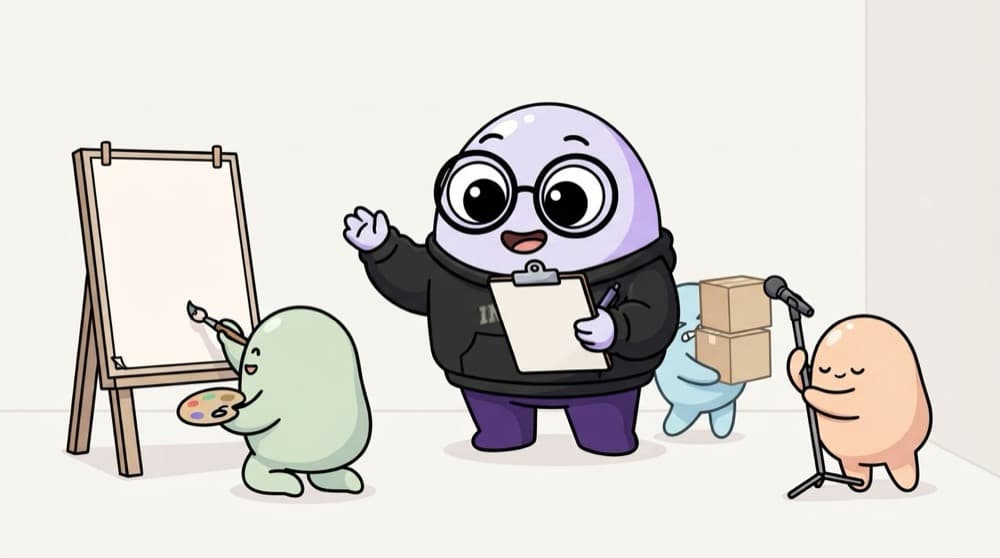
Nobody runs a fest alone. One team gets sponsors, one designs posters, one handles stage. The fest head checks in, passes notes between teams and signs off. Multi-agent systems are the same: several focused agents, one coordinator.
Watch it happen
A small crew writes a blog post
find 3 facts on UPI
1/6The manager gives the researcher a narrow task with a clear expected output.
The big ideas
What you need to know
One role, one job
Give each agent a role, a goal and only the tools it needs. Narrow agents make fewer weird choices.
Who talks to whom
Sequential (A then B), manager-led (a boss assigns tasks) or group chat. Pick the simplest pattern that works.
CrewAI and AutoGen
CrewAI is built around roles and tasks. AutoGen, from Microsoft, is built around agents chatting in conversations.
More agents, more cost
Every agent turn is another LLM call. Three agents can cost several times one agent, so measure if the quality gain is worth it.
See it in code
Walk through the code
1from crewai import Agent, Task, Crew2 3researcher = Agent(role="Researcher", goal="Find accurate facts about UPI",4 backstory="A careful fact-checker who notes sources")5writer = Agent(role="Writer", goal="Explain UPI simply to students",6 backstory="Writes short, friendly blog posts")7 8facts = Task(description="Collect 3 facts on how a UPI payment works",9 expected_output="3 bullet points with sources", agent=researcher)10post = Task(description="Write a 150-word post using the facts",11 expected_output="A 150-word blog post", agent=writer)12 13crew = Crew(agents=[researcher, writer], tasks=[facts, post])14print(crew.kickoff())1/3Two agents, each with a role, a goal and a backstory that shapes how it behaves.
A two-agent CrewAI crew. Tasks run in order, and the first task's output is passed to the second as context.
Save yourself the pain
Common mistakes
Oops
Starting with five agents because it looks impressive in a demo.
Do this instead
Start with one agent. Split into more only when you can point to a specific failure that a separate role fixes.
Oops
Letting agents chat with no turn limit.
Do this instead
Set a max number of rounds. Two polite agents can thank each other forever.
Your mission
Build a two-agent crew
Quick check
Why give the writer agent no search tools?
Go deeper
- 1Build a simple two-agent system (e.g. a worker and a reviewer) using AutoGen or CrewAI.
- 2Learn the coordination patterns: sequential, hierarchical, and debate-style.
- 3Identify when a multi-agent design actually beats a well-prompted single agent — it isn't always worth the added complexity.
More topics at this stop
 Agent Architectures (ReAct, Plan-and-Execute)
 LangChain
 LlamaIndex
 Function/Tool Calling for Agents
 Memory in Agents
 Agent Guardrails
 Model Context Protocol (MCP, Overview)
 Workflow Orchestration

Stuck on this topic? Ask an Insider
Get 1:1 guidance from people who've walked this exact path — on the InsideEdge app.
