
In short
Anagrams, palindromes, longest substring: string questions are everywhere. Most are array tricks in disguise, plus one good habit: counting characters.
Text-processing problems — often array problems in disguise, but with their own common patterns around characters, substrings and comparisons.
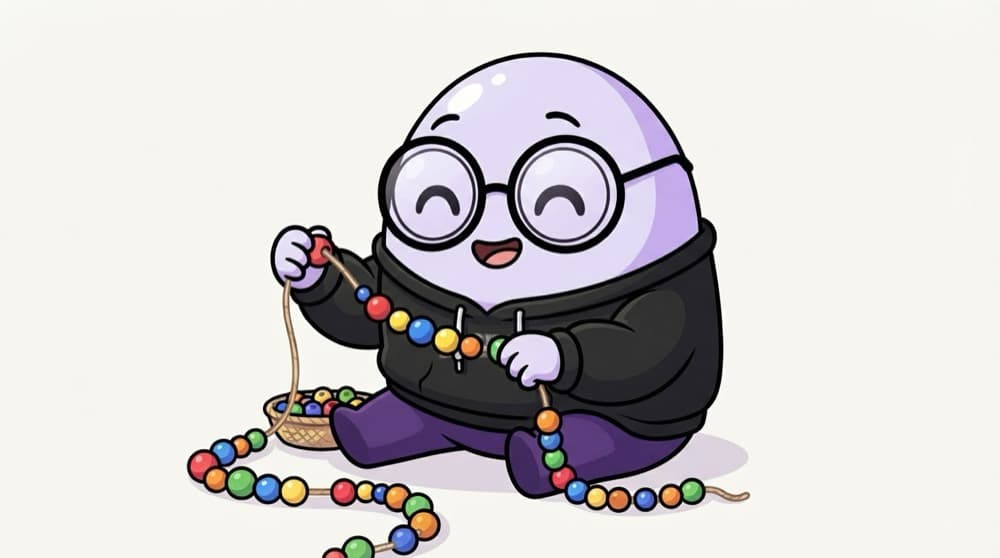
Think of it like this
Beads on a garland
A string is beads on a thread, one character per bead, in a fixed order. You can look at any bead, but you can't swap one out without making a new garland. That's why strings are called immutable.
Watch it happen
Is "racecar" a palindrome?
1/4Put one pointer at each end. Both are "r", so far so good.
The big ideas
What you need to know
Strings are immutable
s[0] = "x" never changes a string. Methods like replace or toUpperCase return a brand new string instead.
Count the characters
Anagram, "first unique character" and many more are solved by counting how often each character appears with a Map or a 26-slot array.
Two pointers work here too
Palindromes and reversing are classic two-pointer problems, one from each end, moving inwards.
Slicing has a cost
s.slice(i, j) copies characters. Slicing inside a loop adds hidden work, so pass indexes around when you can.
See it in code
Walk through the code
1function isAnagram(a: string, b: string): boolean {2 if (a.length !== b.length) return false;3 4 const count = new Map<string, number>();5 for (const ch of a) count.set(ch, (count.get(ch) ?? 0) + 1);6 7 for (const ch of b) {8 const left = (count.get(ch) ?? 0) - 1;9 if (left < 0) return false; // b has a character a didn't10 count.set(ch, left);11 }12 return true;13}14 15console.log(isAnagram("listen", "silent")); // true1/3Different lengths can never be anagrams. Cheap early exit.
Counting is O(n). Sorting both strings and comparing also works, but costs O(n log n).
Save yourself the pain
Common mistakes
Oops
Trying to change a character with s[i] = "x".
Do this instead
Convert to an array with [...s], change it, then join("") it back into a string.
Oops
Forgetting about case and spaces in palindrome questions.
Do this instead
Ask the interviewer first, then normalise with toLowerCase() and remove non-letters if needed.
Your mission
Three string classics
Quick check
You run const s = "chai"; s.toUpperCase(); console.log(s). What prints?
Go deeper
- 1Solve classic string problems: palindrome check, anagram check, longest substring.
- 2Learn common patterns: sliding window, character frequency maps.
- 3Practice both the brute-force and optimized solution for a few problems.
More topics at this stop
 Arrays
 Linked List
 Stack
 Queue
 HashMap
 Heap
 Tree
 Graph
 Binary Search
 Recursion
 Backtracking
 Sliding Window
 Greedy
 Dynamic Programming
 Sorting
 Searching

Stuck on this topic? Ask an Insider
Get 1:1 guidance from people who've walked this exact path — on the InsideEdge app.
