ML System Design Questions
Part of the Data Science Roadmap
In short
'Design a recommendation system for a food app.' There's no single right answer. They want to see you think through data, features, model, serving and monitoring in a sensible order.
'Design a recommendation system for X' — testing whether you can think through the full pipeline: data, features, model choice, evaluation, and deployment, at a systems level.
Think of it like this
Catering a big wedding
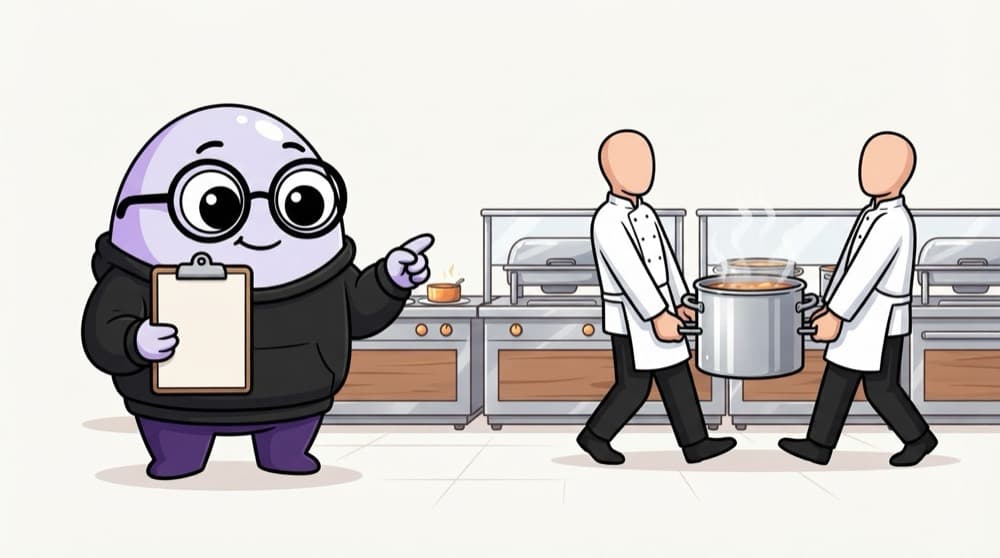
Cooking for your family and catering a 1,000-guest wedding are different problems. The caterer plans the menu, sources ingredients, preps ahead, keeps food hot at counters and watches which dish runs out. ML system design asks you to plan at that scale.
Watch it happen
Designing 'recommended dishes'
1/6Clarify the goal (more orders? more repeat users?), the scale, and how fast results must load.
The big ideas
What you need to know
Requirements before models
Ask about the goal, users, scale and latency first. It shapes every later choice.
Simple baseline first
'Most popular nearby' is a real baseline. Your model must beat it in an A/B test.
Candidates, then ranking
A cheap step narrows millions of items to hundreds; a heavier model ranks those.
Plan for life after launch
Monitoring, retraining, feedback loops and cold start are part of the design.
Save yourself the pain
Common mistakes
Oops
Jumping straight to 'I'd use a deep neural network'.
Do this instead
Start with requirements and a baseline, then justify each step up in complexity.
Oops
Ignoring serving: latency, cost and what happens when the model fails.
Do this instead
Talk about precomputation, caching, fallbacks like 'popular items', and monitoring.
Your mission
Design one system in 35 minutes
Quick check
Why do many recommendation systems use candidate generation followed by ranking?
Go deeper
- 1Practice a repeatable structure: clarify requirements, data, features, model, evaluation, deployment.
- 2Prepare 1-2 fully worked-through examples (e.g. a recommendation system, a fraud detector).
- 3Practice out loud — this format rewards structured thinking over a single 'right' architecture.
More case studies & product sense at this stop
 Case Study / Business Problem Questions
 A/B Testing & Experimentation Questions

Stuck on this topic? Ask an Insider
Get 1:1 guidance from people who've walked this exact path — on the InsideEdge app.
