Multithreaded File Processor
Part of the Java Roadmap
In short
This project puts the whole phase to work: a thread pool, Callables, Futures, thread-safe results and a timing comparison. It is a small, honest way to show you understand concurrency.
A program that processes many log or CSV files in parallel using an ExecutorService, combines the results safely and reports the total time against a single-threaded version.
Think of it like this
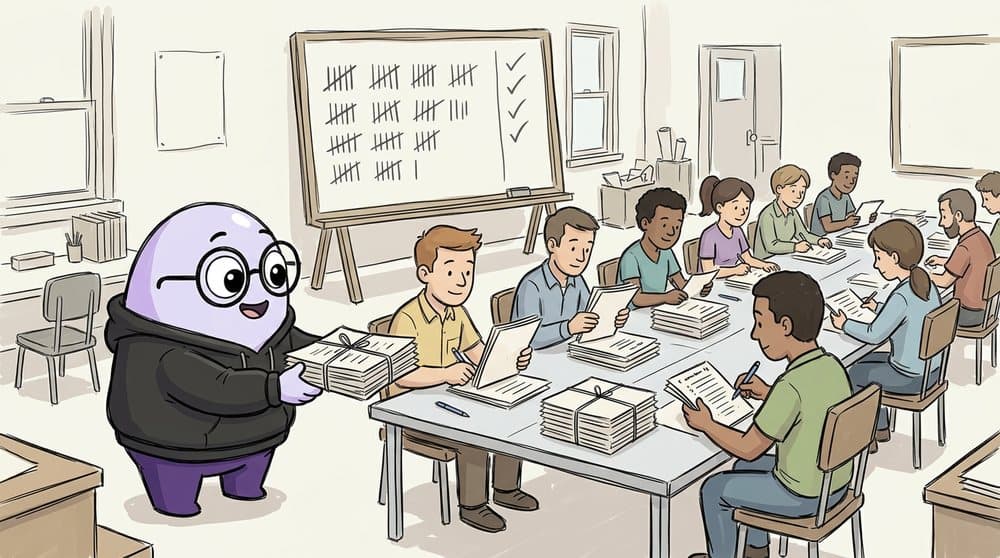
Exam copies at the board office
A board office in Lucknow has thousands of answer sheets. One examiner would take months. Instead the sheets are split into bundles, eight examiners check bundles at the same time, and a supervisor adds up the marks at the end. Your program does the same with log files.
The big ideas
What you need to know
Split the work
Independent units like files are perfect for parallelism because they share no state.
Merge, don't share
Let each task return its own result and combine them at the end. That avoids locks entirely.
Measure honestly
Use System.nanoTime(), warm up once and run several times. Disk speed can limit the gains.
Handle failures
One unreadable file should be logged and skipped, not crash the whole run. Catch ExecutionException per Future.
How it works
Build it step by step
- 1
List files
Use Files.list or Files.walk to find every .log file in a folder.
- 2
One task per file
Wrap each file in a Callable<Map<String, Long>> that counts ERROR, WARN and INFO lines.
- 3
Run in a pool
Submit all tasks to a fixed pool sized to the number of cores, or virtual threads.
- 4
Merge safely
Combine results on the main thread from the Futures, so no shared mutable map is needed.
- 5
Compare timing
Run the same job single-threaded and print both times in a small table.
See it in code
Walk through the code
1import java.nio.file.*;2import java.util.*;3import java.util.concurrent.*;4import java.util.stream.*;5 6public class LogProcessor {7 public static void main(String[] args) throws Exception {8 List<Path> files;9 try (Stream<Path> s = Files.list(Path.of("logs"))) {10 files = s.filter(p -> p.toString().endsWith(".log")).toList();11 }12 13 long start = System.nanoTime();14 Map<String, Long> total = new TreeMap<>();15 int cores = Runtime.getRuntime().availableProcessors();16 17 try (ExecutorService pool = Executors.newFixedThreadPool(cores)) {18 List<Future<Map<String, Long>>> futures = files.stream()19 .map(f -> pool.submit(() -> countLevels(f)))20 .toList();21 for (Future<Map<String, Long>> fut : futures) {22 try {23 fut.get().forEach((k, v) -> total.merge(k, v, Long::sum));24 } catch (ExecutionException e) {25 System.err.println("Skipped a file: " + e.getCause());26 }27 }28 }29 System.out.printf("%s in %d ms%n", total, (System.nanoTime() - start) / 1_000_000);30 }31 32 static Map<String, Long> countLevels(Path file) throws Exception {33 try (Stream<String> lines = Files.lines(file)) {34 return lines.map(l -> l.split(" ", 3))35 .filter(parts -> parts.length > 1)36 .collect(Collectors.groupingBy(parts -> parts[1], Collectors.counting()));37 }38 }39}1/4List the .log files, closing the directory stream with try-with-resources.
Assumes lines like "2026-11-02 ERROR Payment failed". Each file is counted on its own thread and merged on main.
Save yourself the pain
Common mistakes
Oops
Having every thread write into one shared HashMap.
Do this instead
HashMap is not thread-safe. Return per-file results and merge them, or use ConcurrentHashMap.merge.
Oops
Creating one platform thread per file for 50,000 files.
Do this instead
Use a bounded pool, or virtual threads, so the machine isn't flooded with threads.
Oops
Reporting a 10x speed-up from a single run.
Do this instead
Run each version a few times, and mention that disk I/O and file size affect the result.
Your mission
Ship the project
Quick check
Why does the example merge results on the main thread instead of sharing one map across tasks?
Go deeper
- 1Submit one task per file to a fixed thread pool and collect Futures.
- 2Merge per-file results with a ConcurrentHashMap or by combining returned values.
- 3Compare run times with 1, 2, 4 and 8 threads and explain the results.

Stuck on this topic? Ask an Insider
Get 1:1 guidance from people who've walked this exact path — on the InsideEdge app.
