
Garbage Collection Basics
Part of the Java Roadmap
In short
In Java you never call free(). The garbage collector finds objects nobody can reach anymore and reclaims their memory. Understanding it helps you avoid leaks and long pauses.
The JVM automatically frees objects that are no longer reachable. Most collectors are generational, and G1 is the default in modern JDKs. You can still leak memory by holding unwanted references.
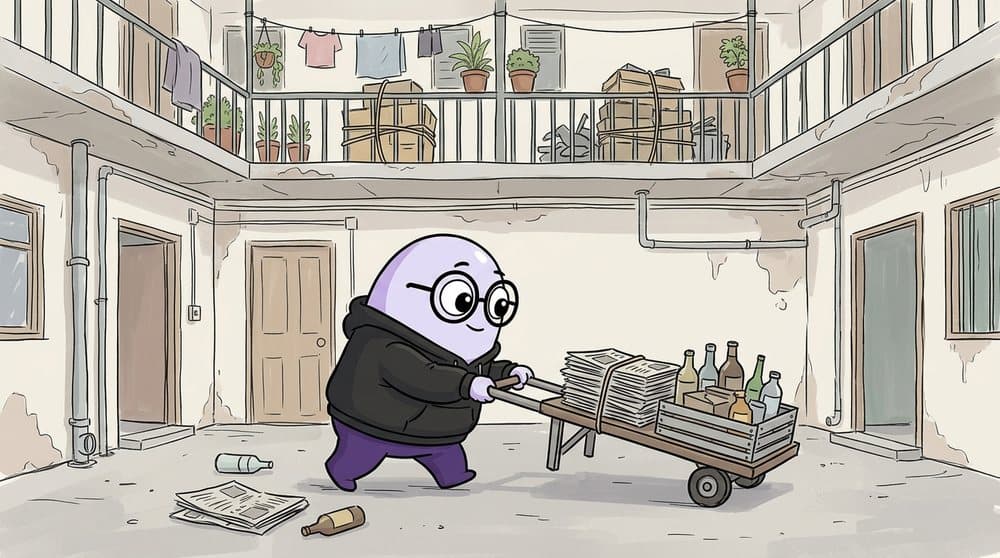
Think of it like this
The kabadiwala round
Every week the kabadiwala visits your building. Anything still tied to a flat with a string, he leaves alone. Anything lying loose with no string to anyone, he takes away. The GC starts from roots like running threads and static fields, follows every reference, and collects whatever it can't reach.
Watch it happen
What is reachable from GC roots
1/4The GC starts from roots: live thread stacks, static fields and JNI references.
The big ideas
What you need to know
Reachability
An object is alive if any chain of references leads to it from a GC root. Cycles of unreachable objects are collected too.
Generations
Most objects die young. New objects go to the young generation, which is collected often and cheaply. Survivors move to the old generation.
G1 by default
G1 is the default collector on modern JDKs. ZGC is an option for very low pause times on large heaps.
Leaks still happen
Static collections that only grow, unclosed listeners and caches without limits keep objects reachable forever.
See it in code
Walk through the code
1import java.util.*;2 3public class SessionStore {4 // Leak: this map only ever grows5 private static final Map<String, byte[]> SESSIONS = new HashMap<>();6 7 static void login(String userId) {8 SESSIONS.put(userId + System.nanoTime(), new byte[100_000]);9 }10 11 static void logout(String key) {12 SESSIONS.remove(key); // fix: always remove when done13 }14 15 public static void main(String[] args) {16 for (int i = 0; i < 1_000_000; i++) {17 login("user" + i);18 }19 }20}1/3A static field is a GC root. Everything inside this map stays reachable.
Run with java -Xmx128m -Xlog:gc SessionStore.java and watch GC work harder until OutOfMemoryError.
Save yourself the pain
Common mistakes
Oops
Calling System.gc() to fix memory problems.
Do this instead
It is only a hint and may cause a full pause. Find out what is keeping objects reachable instead.
Oops
Thinking Java cannot have memory leaks.
Do this instead
Anything still referenced, like entries in a static map, can never be collected. That is a Java memory leak.
Oops
Relying on finalize() to clean up files or sockets.
Do this instead
finalize is deprecated for removal. Use try-with-resources so close() runs at a known time.
Your mission
Watch the collector
Quick check
Two objects reference each other, but nothing else references either of them. What happens?
Go deeper
- 1Learn what makes an object eligible for garbage collection.
- 2Watch heap usage of a running app with VisualVM or JDK Mission Control.
- 3Find a memory leak caused by an ever-growing static collection.
More topics at this stop
 Threads & Runnable
 Synchronization & Locks
 Race Conditions & Deadlocks
 volatile & the Java Memory Model
 ExecutorService & Thread Pools
 CompletableFuture
 Virtual Threads
 JVM Memory (Heap & Stack)

Stuck on this topic? Ask an Insider
Get 1:1 guidance from people who've walked this exact path — on the InsideEdge app.
