
Task Manager REST API
Part of the Java Roadmap
In short
This is the project that proves you can build a real backend: layered code, a database, validation, clean errors and tests. Small enough to finish in a week, solid enough to discuss for twenty minutes in an interview.
A Spring Boot API for creating, updating, filtering and completing tasks, backed by MySQL or PostgreSQL. It shows you can build a clean, layered backend with tests.
Think of it like this
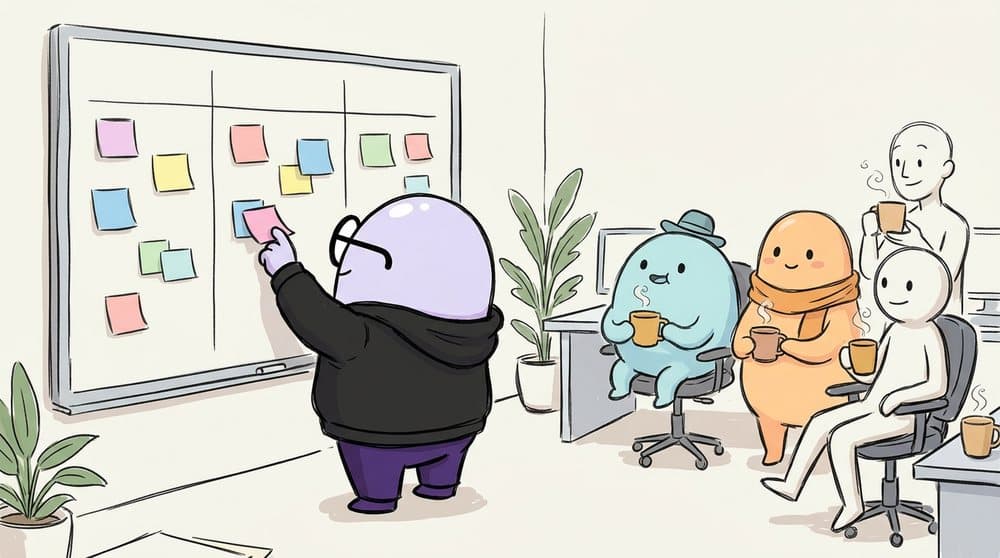
The team whiteboard
A startup team in Kochi keeps a whiteboard with sticky notes for every task: who owns it, when it's due and whether it's done. People add notes, move them, and peel them off when finished. Your API is that whiteboard for an app, with each endpoint a way to add, move or finish a note.
The big ideas
What you need to know
Enum for status
Store status as @Enumerated(EnumType.STRING) so the database holds readable values, not numbers.
Filtering and paging
GET /api/tasks?status=TODO&page=0&size=10 using a Pageable repository method.
A business rule
A DONE task can't move back to TODO. Enforce it in the service and return 409 Conflict.
Tests that matter
Test the rule, the 404 for a missing task and a validation error. Mention coverage in your README.
How it works
Build plan
- 1
Model
Task entity: id, title, description, status (TODO, IN_PROGRESS, DONE), priority, dueDate, timestamps.
- 2
Schema
Flyway V1 creates the tasks table in PostgreSQL or MySQL.
- 3
Layers
TaskRepository, TaskService with business rules, TaskController with DTO records.
- 4
Quality
Validation on requests, a GlobalExceptionHandler and filtering with ?status=DONE&page=0.
- 5
Proof
Controller and service tests, Swagger UI, a Dockerfile and a README with sample requests.
See it in code
Walk through the code
1import jakarta.persistence.*;2import jakarta.validation.constraints.*;3import java.time.LocalDate;4 5enum Status { TODO, IN_PROGRESS, DONE }6 7@Entity8class Task {9 @Id @GeneratedValue(strategy = GenerationType.IDENTITY)10 Long id;11 String title;12 @Enumerated(EnumType.STRING)13 Status status = Status.TODO;14 LocalDate dueDate;15}16 17record CreateTaskRequest(@NotBlank @Size(max = 120) String title,18 @FutureOrPresent LocalDate dueDate) {}19 20class TaskService {21 private final TaskRepository repo;22 TaskService(TaskRepository repo) { this.repo = repo; }23 24 @org.springframework.transaction.annotation.Transactional25 public Task changeStatus(Long id, Status next) {26 Task task = repo.findById(id).orElseThrow(() -> new TaskNotFoundException(id));27 if (task.status == Status.DONE && next == Status.TODO) {28 throw new InvalidTransitionException("A finished task cannot go back to TODO");29 }30 task.status = next; // dirty checking saves it at commit31 return task;32 }33}1/6A small enum keeps status values fixed and type-safe.
The core pieces, simplified with package-private fields. Add the controller, exception handler and tests from earlier lessons. Mark TaskService with @Service in your project.
Save yourself the pain
Common mistakes
Oops
Putting all logic in the controller.
Do this instead
Controllers handle HTTP. Rules like status transitions belong in the service, where they're easy to test.
Oops
Using @Enumerated(EnumType.ORDINAL) or the default.
Do this instead
Ordinal stores 0, 1, 2. Reordering the enum later silently corrupts data. Use STRING.
Oops
Shipping without a README.
Do this instead
Add setup steps, an endpoint table, sample curl requests and a screenshot of Swagger UI.
Your mission
Ship the Task Manager
Quick check
Why store the status enum with EnumType.STRING?
Go deeper
- 1Use controller, service and repository layers with DTOs.
- 2Add validation, global error handling and pagination.
- 3Write unit tests with Mockito and document endpoints with Swagger (springdoc-openapi).
More projects at this stop
 E-Commerce Backend with Spring Boot

Stuck on this topic? Ask an Insider
Get 1:1 guidance from people who've walked this exact path — on the InsideEdge app.
