
In short
Thirty students' marks, seven days of temperatures, a cinema hall of seats: when you have many values of the same kind, you want them in one numbered row, not thirty separate variables.
Arrays hold a fixed number of elements of one type, indexed from 0. 2D arrays are arrays of arrays, useful for grids and matrices. Accessing an invalid index throws ArrayIndexOutOfBoundsException.
Think of it like this
Hostel rooms on a corridor
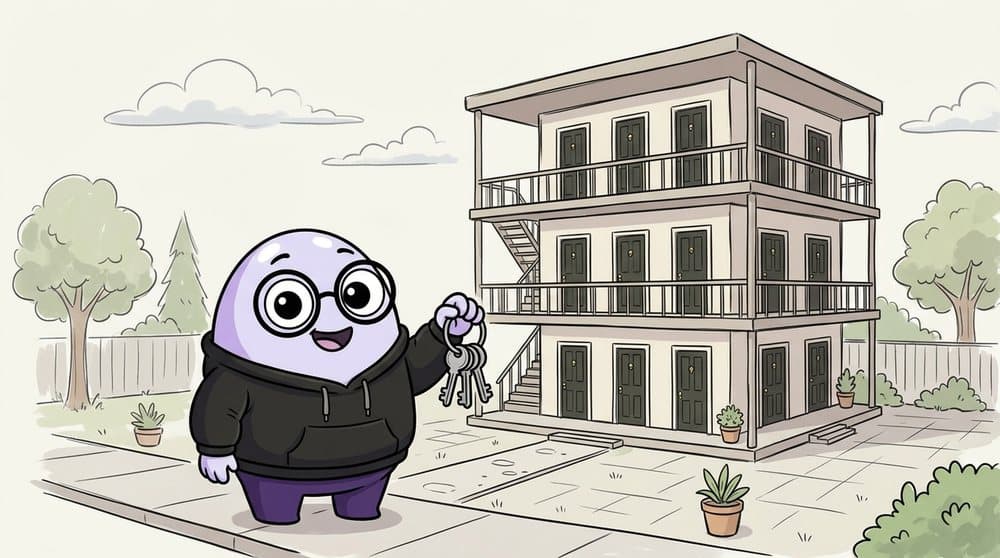
A hostel corridor has rooms numbered 0, 1, 2 and so on, all the same size, and the number of rooms is fixed when it is built. That is an array. A whole hostel with several floors, each with its own corridor, is a 2D array: you need a floor number and a room number.
Watch it happen
int[] marks = {78, 92, 65, 88, 71}
1/5Five ints in one block. Indexes go from 0 to 4, and marks.length is 5.
The big ideas
What you need to know
Fixed size
new int[5] makes exactly five slots, all starting at 0. You cannot grow an array; use ArrayList for that.
Zero-based
The first element is [0] and the last is [length - 1]. Going outside throws ArrayIndexOutOfBoundsException.
2D = array of arrays
int[][] grid = new int[3][4]; is 3 rows of 4. grid[row][col] reaches one cell.
Arrays helper class
Arrays.toString, Arrays.sort, Arrays.fill and Arrays.copyOf save you from writing loops.
See it in code
Walk through the code
1import java.util.Arrays;2 3public class Marks {4 public static void main(String[] args) {5 int[] marks = {78, 92, 65, 88, 71};6 7 int total = 0;8 for (int m : marks) total += m;9 double avg = (double) total / marks.length;10 11 int[] sorted = Arrays.copyOf(marks, marks.length);12 Arrays.sort(sorted);13 System.out.println(Arrays.toString(sorted)); // [65, 71, 78, 88, 92]14 System.out.println("Average: " + avg);15 16 // 3 students x 2 subjects17 int[][] scores = {18 {80, 75},19 {90, 85},20 {60, 70}21 };22 for (int s = 0; s < scores.length; s++) {23 int sum = 0;24 for (int sub = 0; sub < scores[s].length; sub++) {25 sum += scores[s][sub];26 }27 System.out.println("Student " + (s + 1) + " total: " + sum);28 }29 }30}1/5An array literal. Java counts the elements and sets the length to 5.
Summing, averaging and sorting a 1D array, then totalling each row of a 2D array.
Save yourself the pain
Common mistakes
Oops
System.out.println(marks); and seeing [I@1b6d3586.
Do this instead
Arrays do not print their contents. Use Arrays.toString(marks), or Arrays.deepToString for 2D.
Oops
Looping with i <= marks.length.
Do this instead
The last valid index is length - 1. Use i < marks.length.
Your mission
Weekly temperatures
Quick check
Given int[] a = new int[4];, what is a[4]?
Go deeper
- 1Find the sum, average and max of an int array.
- 2Add and multiply two matrices using 2D arrays.
- 3Use Arrays.toString() and Arrays.sort() from java.util.Arrays.
More topics at this stop
 If-Else Statements
 Switch Statements & Switch Expressions
 For, While & Do-While Loops
 Break & Continue
 Defining Methods
 Method Overloading
 Pass-by-Value in Java

Stuck on this topic? Ask an Insider
Get 1:1 guidance from people who've walked this exact path — on the InsideEdge app.
