
In short
Before Java 8, passing a tiny piece of behaviour meant writing a five-line anonymous class. Lambdas let you write the same thing in one readable line, and every modern Java codebase is full of them.
Lambdas (Java 8+) are short anonymous functions like (a, b) -> a + b. They implement functional interfaces and replace most anonymous inner classes.
Think of it like this
The sticky note instead of a letter
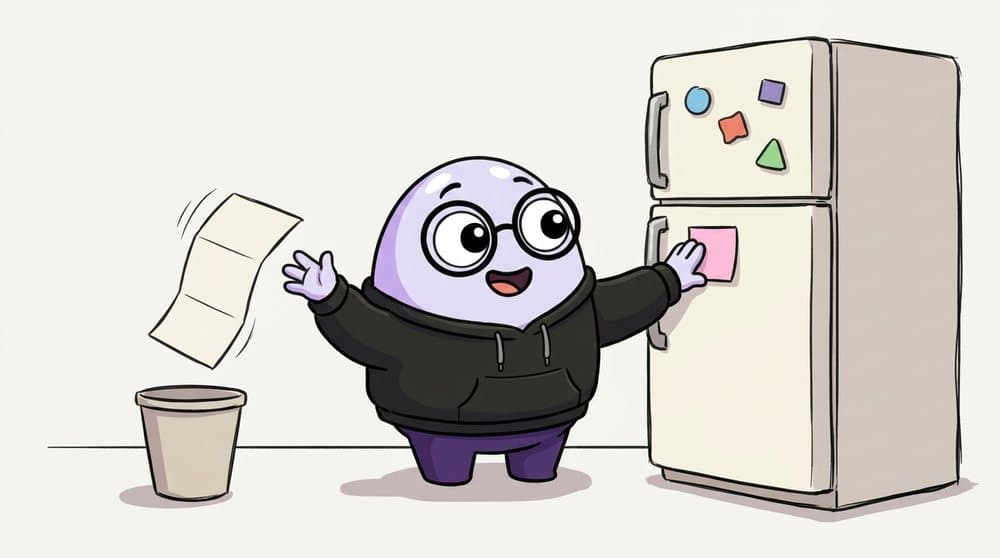
You want your flatmate to buy milk. You could write a formal letter with an address, greeting and signature (an anonymous class). Or you stick a note on the fridge: 'milk -> buy 2 packets'. A lambda is that sticky note: just the inputs, an arrow and what to do.
Watch it happen
Same sort, two ways
Anonymous class
- new Comparator<String>() { ... }
- Needs @Override and a full method signature
- Five or six lines for one comparison
- Creates a separate .class file
Lambda
- (a, b) -> a.compareTo(b)
- Parameter types are inferred
- One line, easy to read
- Works anywhere a functional interface is expected
Use a lambda whenever the target is a functional interface. Keep anonymous classes only when you need extra fields or several methods.
The big ideas
What you need to know
Shape: params -> body
x -> x * 2 for one parameter, (a, b) -> a + b for two, () -> 42 for none. Brackets are optional only with exactly one parameter.
Expression or block
A single expression returns its value automatically. With curly braces you write normal statements and need an explicit return.
Effectively final captures
A lambda can read local variables from the surrounding method, but only if they are never reassigned after being set.
Needs a target type
A lambda has no type of its own. It becomes a Comparator, Runnable or Predicate depending on where you pass it.
See it in code
Walk through the code
1import java.util.ArrayList;2import java.util.Comparator;3import java.util.List;4 5public class LambdaDemo {6 public static void main(String[] args) {7 List<String> names = new ArrayList<>(List.of("Ravi", "Aisha", "Meera", "Kabir"));8 9 // Old way: anonymous inner class10 names.sort(new Comparator<String>() {11 @Override12 public int compare(String a, String b) {13 return a.compareTo(b);14 }15 });16 17 // Lambda: reverse order in one line18 names.sort((a, b) -> b.compareTo(a));19 20 names.forEach(name -> System.out.println("Hello, " + name));21 22 int minLength = 5;23 names.removeIf(name -> name.length() < minLength);24 System.out.println(names); // [Meera, Kabir, Aisha]25 }26}1/4The pre-Java 8 way: a whole anonymous class just to compare two strings.
The same list sorted with an anonymous class and with a lambda, then printed and filtered with two more lambdas.
Save yourself the pain
Common mistakes
Oops
int count = 0; names.forEach(n -> count++);
Do this instead
This does not compile: captured locals must be effectively final. Use names.size(), a stream count(), or a normal for loop.
Oops
(a, b) -> { a + b; }
Do this instead
With braces you need a return: (a, b) -> { return a + b; }, or drop the braces: (a, b) -> a + b.
Oops
Writing a 20-line lambda with nested ifs.
Do this instead
Move long logic into a named private method and pass it with a method reference. Lambdas should stay short.
Your mission
Replace the anonymous classes
Quick check
Which lambda correctly returns the larger of two ints?
Go deeper
- 1Rewrite an anonymous Comparator class as a lambda.
- 2Use list.forEach() and list.removeIf() with lambdas.
- 3Learn that lambdas can only use local variables that are effectively final.
More topics at this stop
 Functional Interfaces
 Method References
 Stream API Basics (filter, map, reduce)
 Collectors & groupingBy
 Optional
 Parallel Streams

Stuck on this topic? Ask an Insider
Get 1:1 guidance from people who've walked this exact path — on the InsideEdge app.
