
What Machine Learning Is (and Isn't)
Part of the Machine Learning Roadmap
In short
Normal programs follow rules a person wrote. Machine learning flips that: you show the computer lots of examples with answers, and it works out the rules by itself. Knowing when that helps, and when it doesn't, is the first real ML skill.
Machine learning builds programs that learn patterns from examples instead of following hand-written rules. It shines when you have plenty of relevant data and a clear target, and it is the wrong tool when a simple rule works or the data is tiny or biased.
Think of it like this
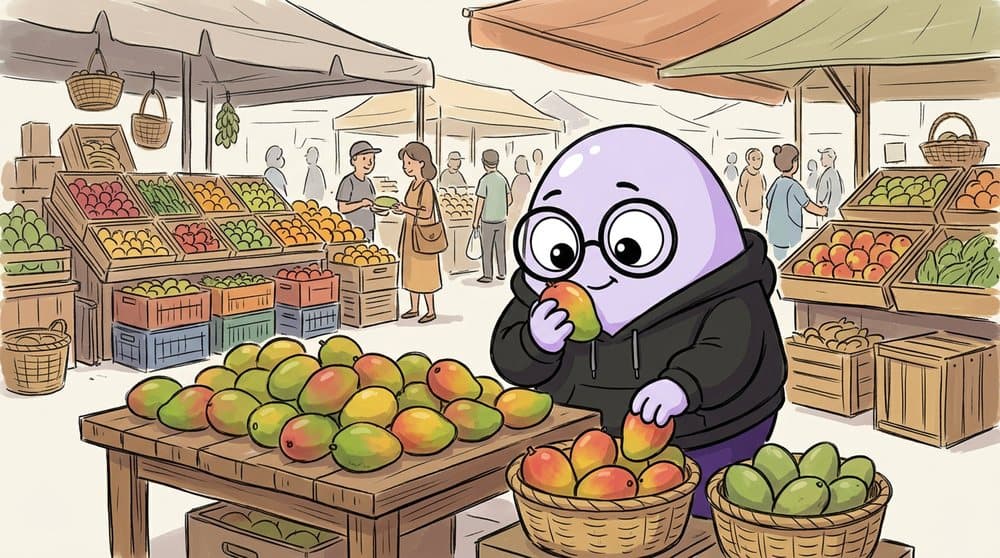
Nani picking mangoes
Ask your nani how she picks ripe mangoes and she can't write you a rulebook. She has simply squeezed and sniffed thousands of them, and her hands learned the pattern. ML learns the same way: from many examples, not from a rule someone typed. But if the rule is simple, like 'stickers marked A are export quality', you don't need nani's years of practice. You just read the sticker.
Watch it happen
Hand-written rules vs a learned model
Traditional program
- A person writes the rules: if softness > 6 and smell > 5, it's ripe.
- Works well when the rule is simple and stable.
- Breaks when the pattern is fuzzy or keeps changing.
Machine learning
- You give examples with answers: 1,000 mangoes marked ripe or not.
- The algorithm finds the rule that best fits those examples.
- Needs enough good data, and can only be as fair as that data.
Use ML when the pattern is too fuzzy to write down but you have plenty of labelled examples. If a simple rule works, use the rule.
The big ideas
What you need to know
Data in, rules out
A program takes rules plus data and gives answers. ML takes data plus answers and gives you the rules, called a model.
It needs a clear target
You must say exactly what to predict: ripe or not, price in rupees, spam or not. A vague goal gives a useless model.
It is not magic
A model only knows patterns in its training data. Tiny, wrong or biased data gives tiny, wrong or biased predictions.
Sometimes a rule wins
Checking if a PIN code has six digits needs one line of code, not a model. ML is for patterns you can't easily spell out.
See it in code
Walk through the code
1from sklearn.tree import DecisionTreeClassifier2 3# Traditional: a person writes the logic4def is_ripe_rule(softness, smell):5 return softness > 6 and smell > 56 7# ML: the model learns the logic from examples8X = [[8, 7], [3, 2], [7, 8], [2, 4], [9, 6], [4, 3]] # softness, smell (1-10)9y = [1, 0, 1, 0, 1, 0] # 1 = ripe, 0 = not ripe10 11model = DecisionTreeClassifier(random_state=0)12model.fit(X, y)13 14print(is_ripe_rule(7, 6)) # True15print(model.predict([[7, 6]])) # [1]1/4The classic approach: a human decides the thresholds.
The same question answered two ways. The rule was typed by a person. The tree found its own rule from six labelled mangoes.
Save yourself the pain
Common mistakes
Oops
Reaching for ML for every problem because it sounds impressive.
Do this instead
First ask if a simple rule or a SQL query solves it. Use ML only when the pattern is too complex to write by hand.
Oops
Believing the model 'understands' the problem.
Do this instead
It only finds statistical patterns in the data you gave it. If the data changes, its answers can quietly go wrong.
Oops
Starting with an algorithm before defining the target.
Do this instead
Write one sentence first: 'Given X, predict Y, so that we can do Z.' Then collect data that matches it.
Your mission
ML or not?
Quick check
Which problem is the best fit for machine learning?
Go deeper
- 1Write down three everyday problems and decide whether each needs ML or a plain if-else rule.
- 2Watch the first lecture of Andrew Ng's Machine Learning Specialization on Coursera.
- 3For one problem that does need ML, list the examples and the target you would need to collect.
More topics at this stop
 ML vs AI vs Deep Learning vs Data Science
 Supervised, Unsupervised & Reinforcement Learning
 Machine Learning Algorithms Explained
 The ML Project Lifecycle
 Features, Labels & Training Data
 ML Engineer vs Data Scientist vs Data Analyst
 Where ML Is Used in Real Products
 Translating Business Problems Into ML Problems
 Setting Up Python, Jupyter & Google Colab

Stuck on this topic? Ask an Insider
Get 1:1 guidance from people who've walked this exact path — on the InsideEdge app.
