
Where ML Is Used in Real Products
Part of the Machine Learning Roadmap
In short
You probably used a dozen ML models before lunch today without noticing. Spotting them in real products teaches you to recognise problem types, which is exactly what interviewers test.
ML powers recommendations on shopping and video apps, fraud checks on UPI payments, delivery time estimates, search ranking, spam filters and credit scoring. Seeing these uses helps you spot what kind of problem (ranking, classification, forecasting) each one is.
Think of it like this
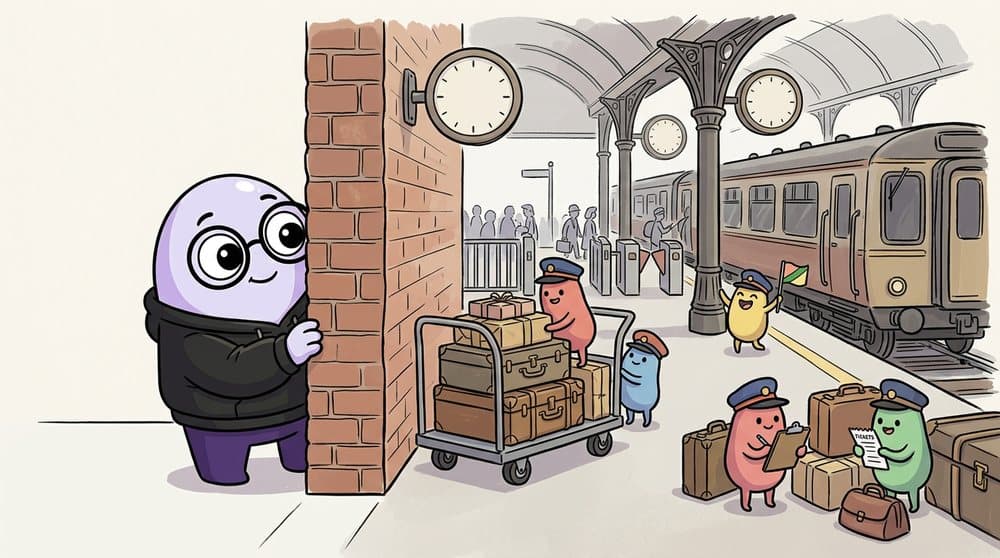
The invisible station staff
At a big railway station you see the trains, but not the people who decide platforms, check tickets, announce delays and sort luggage. ML in apps works like that hidden staff: one model ranks what you see, one checks if a payment looks fishy, one guesses when your food will arrive. Each one does a different kind of job.
Watch it happen
A UPI payment passing a fraud model
Pay ₹4,500
1/4You send money to a new contact at 2 am from a new city.
The big ideas
What you need to know
Classification
Pick a category: spam or not, fraud or not, which product category a photo belongs to.
Regression
Predict a number: delivery time in minutes, house price, tomorrow's demand for onions.
Ranking and recommendation
Order items for one person: search results, YouTube feed, 'customers also bought'.
Clustering and anomalies
Find groups without labels, like customer segments, or flag the rare odd transaction.
See it in code
Walk through the code
1from sklearn.datasets import make_classification2from sklearn.ensemble import RandomForestClassifier3 4# Stand-in for past transactions: 5 features, about 3% fraud5X, y = make_classification(6 n_samples=5000, n_features=5, weights=[0.97], random_state=77)8 9model = RandomForestClassifier(n_estimators=200, random_state=7)10model.fit(X, y)11 12new_payment = X[:1] # pretend this just arrived13risk = model.predict_proba(new_payment)[0, 1]14 15if risk > 0.8:16 print("Ask for extra verification")17else:18 print("Approve")1/4make_classification creates fake data shaped like a rare-fraud problem: most rows are normal.
The shape of a real fraud check: train on past transactions, score each new one, act on a threshold.
Save yourself the pain
Common mistakes
Oops
Describing every product as 'it uses AI'.
Do this instead
Name the task: 'Swiggy's ETA is a regression problem with features like distance, traffic and restaurant prep time.'
Oops
Thinking the model alone makes the decision.
Do this instead
Real systems wrap models with thresholds, rules and human review. The model is one part of the product.
Your mission
ML spotting walk
Quick check
A food delivery app shows 'Arriving in 32 minutes'. What type of ML problem is that?
Go deeper
- 1List five ML features in apps on your phone and guess the label each one predicts.
- 2Read an engineering blog post from an Indian company like Swiggy, Flipkart or Zomato about an ML system.
- 3Pick one use case and write what would go wrong if the model made a mistake.
More topics at this stop
 What Machine Learning Is (and Isn't)
 ML vs AI vs Deep Learning vs Data Science
 Supervised, Unsupervised & Reinforcement Learning
 Machine Learning Algorithms Explained
 The ML Project Lifecycle
 Features, Labels & Training Data
 ML Engineer vs Data Scientist vs Data Analyst
 Translating Business Problems Into ML Problems
 Setting Up Python, Jupyter & Google Colab

Stuck on this topic? Ask an Insider
Get 1:1 guidance from people who've walked this exact path — on the InsideEdge app.
