
One-to-Many and Many-to-Many Relationships
Part of the MERN Stack Roadmap
In short
A user has many orders. A student takes many courses, and each course has many students. These relationships appear in every app, and MongoDB gives you a few clean ways to model each.
One-to-many links, like a user with many orders, and many-to-many links, like students and courses, are modelled with embedded arrays or arrays of referenced ids depending on size and access.
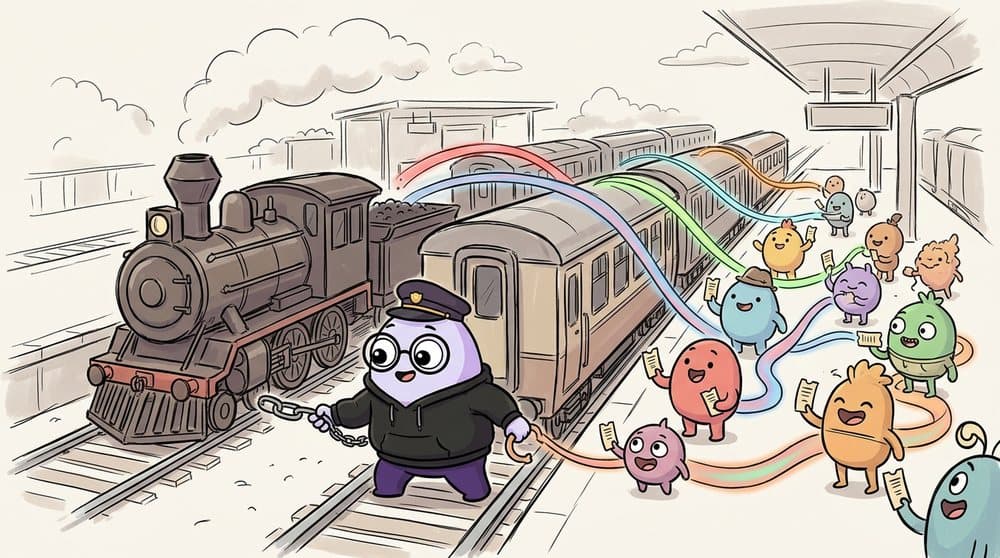
Think of it like this
Trains and passengers
A train has many coaches, always attached to it (one-to-many, few: embed). It carries thousands of passengers over a year, each with a ticket pointing to the train (one-to-many, lots: reference from the child). And passengers travel on many trains while trains carry many passengers (many-to-many).
Watch it happen
Choosing a pattern
1/5First ask: how many on each side, and how will you query it?
The big ideas
What you need to know
One-to-few: embed
Small, bounded lists like addresses or phone numbers sit inside the parent document.
One-to-many: child points up
Orders store userId. Query with find({ userId }) and add an index on userId.
Many-to-many: id arrays
Store an array of ids on one side, such as student.courseIds, when lists stay small.
Link collection
When the relationship has its own data (grade, enrolledOn) or is huge, create a separate collection for it.
See it in code
Walk through the code
1// One-to-many (lots): each order points to its user2db.orders.insertOne({ userId: priyaId, total: 1200, createdAt: new Date() });3db.orders.createIndex({ userId: 1, createdAt: -1 });4db.orders.find({ userId: priyaId }).sort({ createdAt: -1 });5 6// Many-to-many (small): student keeps course ids7db.students.insertOne({ name: "Arjun", courseIds: [dbmsId, osId] });8db.students.find({ courseIds: dbmsId }); // all students in DBMS9 10// Many-to-many with extra data: a link collection11db.enrolments.insertOne({ studentId: arjunId, courseId: dbmsId, grade: "A", enrolledOn: new Date() });12db.enrolments.createIndex({ courseId: 1, studentId: 1 }, { unique: true });1/3Orders reference the user. The compound index makes "my orders, newest first" fast.
Three patterns side by side. Pick based on size and on the queries your screens need.
Save yourself the pain
Common mistakes
Oops
Storing every order id inside the user document.
Do this instead
That array grows forever. Store userId on each order instead and query by it.
Oops
Keeping id arrays on both sides of a many-to-many and updating only one.
Do this instead
Store the link in one place, or use a link collection, so the two sides can't disagree.
Your mission
Model a college portal
Quick check
A blog user may write thousands of posts. How should you link them?
Go deeper
- 1Model students and courses with an enrolments collection and with arrays of ids, and compare.
- 2Store the reference on the many side when the list can grow large.
- 3Practise fetching both sides of a relationship with queries.
Also part of these roadmaps
More topics at this stop
 Data Modeling in MongoDB
 Embedding vs Referencing
 Aggregation Pipeline
 $lookup Joins
 Compound and Text Indexes
 Explain Plans and Query Performance
 Transactions in MongoDB

Stuck on this topic? Ask an Insider
Get 1:1 guidance from people who've walked this exact path — on the InsideEdge app.
