
One-to-Many and Many-to-Many Relationships
Part of the SQL Roadmap
In short
Almost every design question comes down to "how many of these go with how many of those?". Get the answer right and the tables almost design themselves.
One-to-many uses a foreign key on the 'many' side. Many-to-many, like students and courses, needs a junction table holding both keys.
Think of it like this
Books on College Street
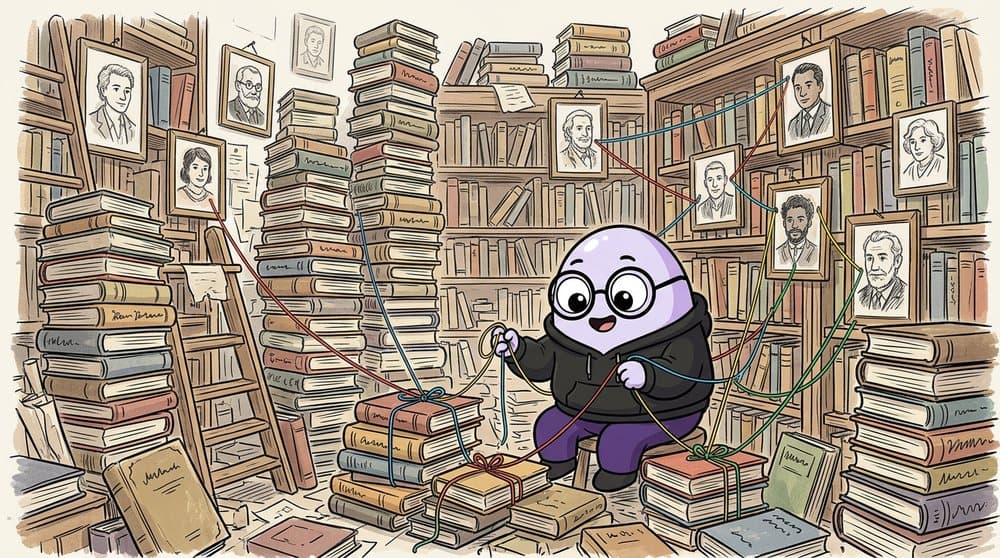
In a College Street bookshop in Kolkata, every book has one publisher, but a publisher prints many books: one-to-many. A book can also have several authors, and an author writes several books: many-to-many. For that, the shop keeps a separate credits register that pairs each author with each book.
Watch it happen
Two relationship shapes
One-to-many
- publishers 1 → many books
- Put publisher_id on books
- Two tables are enough
Many-to-many
- authors many ↔ many books
- Add a junction table book_authors
- It holds author_id and book_id
The foreign key always goes on the 'many' side. When both sides are 'many', create a table in the middle.
The big ideas
What you need to know
FK on the many side
Each book has one publisher, so books gets publisher_id. Never store a list of book IDs on publishers.
Junction tables
book_authors has one row per author and book pair. Three authors on one book means three rows.
Composite primary key
PRIMARY KEY (book_id, author_id) stops the same pair being added twice.
Pairs can carry data
The junction can hold extra columns about the pairing, like author_order or role (author, translator).
See it in code
Walk through the code
1CREATE TABLE books (2 book_id INTEGER GENERATED ALWAYS AS IDENTITY PRIMARY KEY,3 title VARCHAR(200) NOT NULL,4 publisher_id INTEGER NOT NULL REFERENCES publishers (publisher_id)5);6 7CREATE TABLE book_authors (8 book_id INTEGER REFERENCES books (book_id) ON DELETE CASCADE,9 author_id INTEGER REFERENCES authors (author_id),10 author_order SMALLINT NOT NULL DEFAULT 1,11 PRIMARY KEY (book_id, author_id)12);13 14SELECT b.title, a.author_name15FROM books b16JOIN book_authors ba ON ba.book_id = b.book_id17JOIN authors a ON a.author_id = ba.author_id18ORDER BY b.title, ba.author_order;1/4One-to-many: each book stores its single publisher's ID.
A one-to-many link and a many-to-many junction, then a query across them. Assumes publishers and authors tables exist. Works in PostgreSQL. In MySQL and SQL Server, swap the identity syntax for AUTO_INCREMENT or IDENTITY(1,1).
Save yourself the pain
Common mistakes
Oops
Storing authors as a comma-separated string like 'Ruskin Bond, Anita Desai' in books.
Do this instead
You can't join, index or count that properly. Use a book_authors junction table.
Oops
Adding author1_id, author2_id, author3_id columns.
Do this instead
A book with a fourth author breaks the design. A junction table handles any number of authors.
Your mission
Model a food delivery app
Quick check
Students take many courses and courses have many students. How do you model it?
Go deeper
- 1Design a junction table for students and courses with an enrolment date.
- 2Write a query listing each student's courses through the junction table.
- 3Decide what the primary key of the junction table should be.
Also part of these roadmaps
More topics at this stop
 CREATE TABLE
 ALTER TABLE and DROP TABLE
 Choosing Column Data Types
 Constraints and Keys
 Auto-Increment, SERIAL and IDENTITY
 Foreign Keys and ON DELETE Rules
 ER Diagrams
 Normalization (1NF, 2NF, 3NF)
 Denormalization Trade-offs
 Schema Migrations

Stuck on this topic? Ask an Insider
Get 1:1 guidance from people who've walked this exact path — on the InsideEdge app.
