Evaluating AI Feature Quality
Part of the Product Management Roadmap
In short
"I tried it five times and it looked fine" isn't a quality check. AI features need an exam paper, a marking scheme, and lots of real answers to mark.
Measuring an AI feature isn't just 'does it work' — it requires defining what a good vs bad output looks like, at what error rate, and testing against real (not cherry-picked) inputs.
Think of it like this
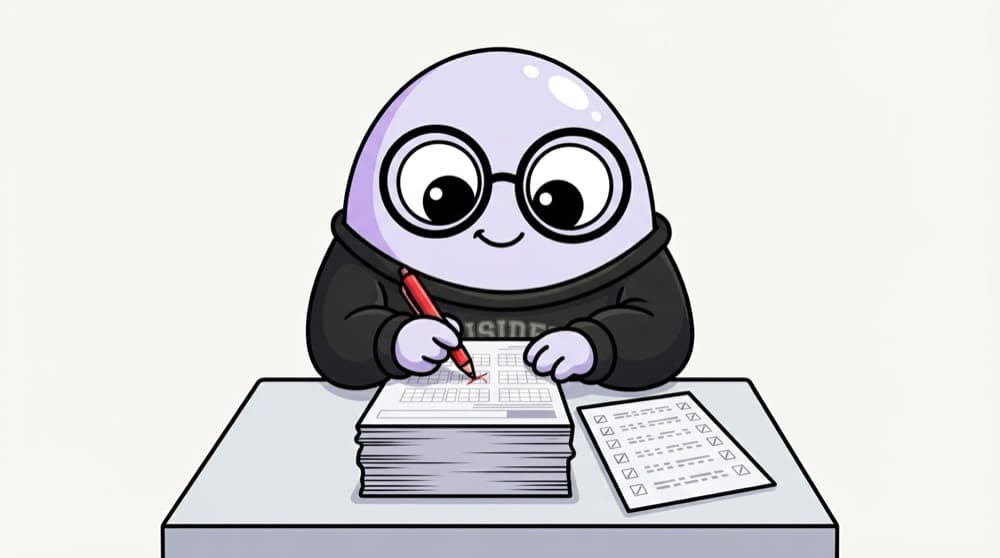
The examiner's marking scheme
Before checking papers, examiners agree on what a full-marks answer looks like. Then they mark a big pile, not just the toppers' sheets. AI evaluation is the same: define good first, then grade many real outputs against it.
Watch it happen
Building an evaluation for an AI summary feature
1/5Write a rubric: summary is accurate, under 80 words, mentions the customer's main issue, no invented details.
The big ideas
What you need to know
Rubric first
Decide what good and bad look like before testing, or you'll grade by mood.
Real, messy inputs
Test on real examples, including edge cases. Cherry-picked demos hide failures.
Not all errors are equal
A typo is minor; a made-up refund promise is serious. Track severe failures separately.
Re-test every change
A new prompt can fix one case and break three others. Keep the test set and rerun it.
See it in code
A tiny example
1=COUNTIF(D2:D101, "pass") / COUNTA(D2:D101)2=COUNTIFS(D2:D101, "fail", E2:E101, "severe")In a sheet where column D holds pass/fail grades and column E holds severity, the first formula gives your pass rate and the second counts severe failures.
Save yourself the pain
Common mistakes
Oops
Testing with ten examples you wrote yourself.
Do this instead
Use a large sample of real user inputs, including the strange ones.
Oops
Reporting one overall score only.
Do this instead
Report the pass rate plus a count of severe failures, since one bad answer can hurt trust badly.
Your mission
Build a tiny eval
Quick check
Your new prompt improves the demo examples. What should you check before shipping?
Go deeper
- 1Define 3 criteria for 'good output' for a hypothetical AI feature.
- 2Learn the basic idea of an eval set: a fixed batch of test inputs you score consistently.
- 3Understand why demo-day performance often overstates real-world reliability.
More topics at this stop
 AI / LLM Product Fundamentals
 Prompt Engineering for PMs
 Designing AI Features (UX for Uncertainty)
 Responsible AI & Ethics Basics
 AI Tools for PM Productivity
 Building a Lightweight AI Prototype (No-Code)

Stuck on this topic? Ask an Insider
Get 1:1 guidance from people who've walked this exact path — on the InsideEdge app.
