
Failure & Learning Stories
Part of the Product Management Roadmap
In short
"Tell me about a time you failed." Saying you've never failed is the only wrong answer. The interviewer wants to see honesty and proof you changed afterwards.
'Tell me about a time something you shipped failed' — testing self-awareness and whether you actually learn from mistakes, not just how you handle success.
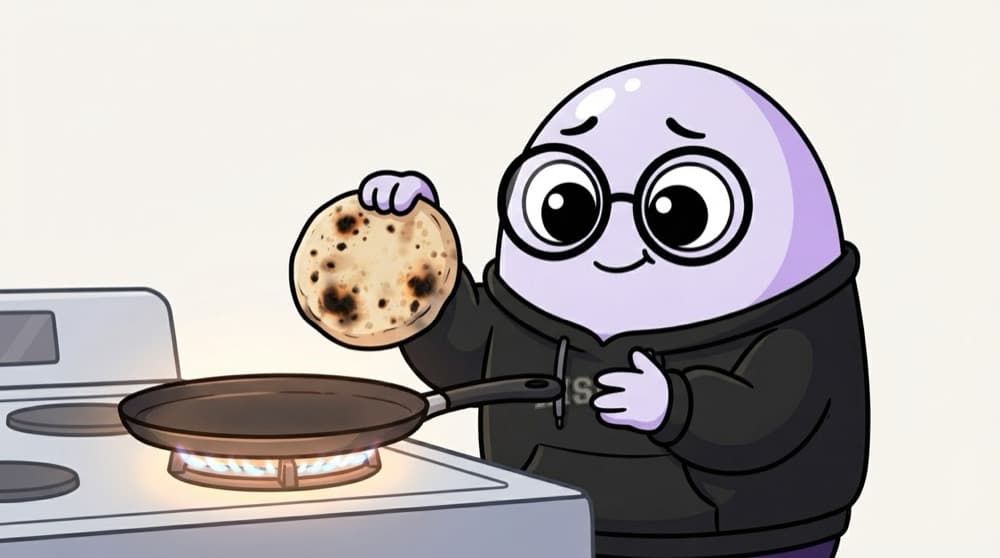
Think of it like this
The first burnt roti
Your first rotis came out burnt on one side and raw on the other. You didn't give up or blame the tawa. You lowered the flame, flipped sooner, and by the tenth they puffed up. The burnt ones are part of the story, not a secret.
Watch it happen
Structuring a failure story
1/5Pick a real failure with some stakes: "I launched a club app feature nobody used."
The big ideas
What you need to know
Pick a real failure
A fake failure like "I work too hard" loses trust immediately.
Own it
Take clear responsibility for your part without blaming others or bad luck.
Show the change
The lesson and what you now do differently matter more than the failure itself.
Prove it stuck
A later example where you applied the lesson closes the loop.
Save yourself the pain
Common mistakes
Oops
Choosing a failure that's secretly a strength.
Do this instead
Pick a genuine mistake with real consequences, then show real growth.
Oops
Blaming teammates, timelines or bad luck.
Do this instead
Focus on what you controlled and what you'd do differently.
Your mission
Write your failure story
Quick check
Which failure story is strongest in an interview?
Go deeper
- 1Prepare a genuine failure story, not a humble-brag disguised as one.
- 2Focus more time on what you learned and changed than on the failure itself.
- 3Practice owning your part in it directly, without deflecting blame to others.
More behavioral at this stop
 Leadership & Ownership Stories
 Conflict & Disagreement Stories
 Cross-Functional Collaboration Stories

Stuck on this topic? Ask an Insider
Get 1:1 guidance from people who've walked this exact path — on the InsideEdge app.
