In short
Python's list hides all the pointer juggling from you, but interviewers love linked lists because they test whether you can reason about references step by step. Reverse one confidently and many other problems become easy.
A linked list is a chain of nodes where each node points to the next. Python doesn't have one built in, but interviewers often ask you to build one with a small Node class and reverse, merge or detect cycles in it.
Think of it like this
The treasure hunt chits
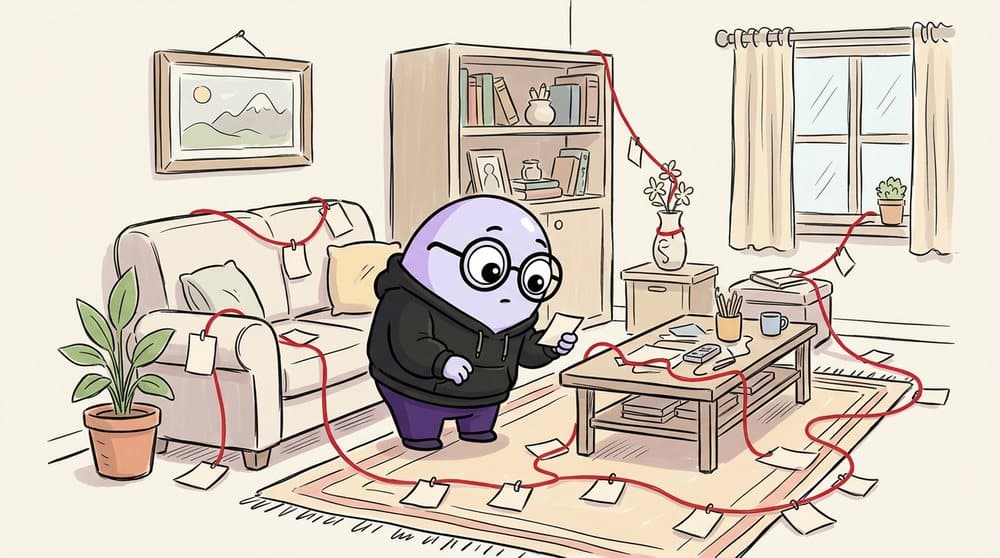
At a birthday treasure hunt, each chit tells you where the next chit is hidden: under the sofa, then behind the fridge, then in the shoe rack. You can't jump to chit five; you follow the chain. A linked list is that chain, and each node holds a value plus a pointer to the next.
Watch it happen
Reversing 10 → 20 → 30
1/4Start: prev is None, curr is the head (10). Each arrow will be flipped one at a time.
The big ideas
What you need to know
A node is tiny
A small class holding value and next. The last node's next is None.
Cheap at the front
Adding or removing at the head is O(1). Reaching the k-th item is O(k), because you must walk there.
Three-pointer reverse
Keep prev, curr and next. Save next, flip curr.next, then move all three forward.
Fast and slow pointers
Move one pointer one step and another two steps. If they ever meet, the list has a cycle.
See it in code
Walk through the code
1from __future__ import annotations2 3from dataclasses import dataclass4 5 6@dataclass7class Node:8 value: int9 next: Node | None = None10 11 12def reverse(head: Node | None) -> Node | None:13 prev: Node | None = None14 curr = head15 while curr is not None:16 nxt = curr.next17 curr.next = prev18 prev = curr19 curr = nxt20 return prev21 22 23def to_list(head: Node | None) -> list[int]:24 out: list[int] = []25 while head is not None:26 out.append(head.value)27 head = head.next28 return out29 30 31chain = Node(10, Node(20, Node(30)))32print(to_list(chain)) # [10, 20, 30]33print(to_list(reverse(chain))) # [30, 20, 10]1/4A dataclass node. The __future__ import lets the class mention Node inside its own definition.
The classic interview question, done in O(n) time and O(1) extra space.
Save yourself the pain
Common mistakes
Oops
Setting curr.next = prev before saving curr.next.
Do this instead
Save it first: nxt = curr.next. Otherwise the rest of the list is unreachable.
Oops
Forgetting to handle an empty list or a single node.
Do this instead
Test with None and one node. The while loop above handles both naturally.
Oops
Using a linked list in everyday Python code.
Do this instead
For real programs, list or deque is almost always better. Linked lists are mainly for interviews and understanding pointers.
Your mission
Linked list drills
Quick check
What is the time complexity of reaching the 1,000th node of a linked list?
Go deeper
- 1Write a Node class and build a list of five nodes.
- 2Reverse a linked list iteratively.
- 3Detect a cycle with the slow and fast pointer technique.
Also part of these roadmaps
More topics at this stop
 Big-O Notation
 Arrays & Strings
 Hash Maps & Sets for Problem Solving
 Two Pointers & Sliding Window
 Stacks & Queues (deque)
 Recursion & Backtracking
 Sorting & Searching
 Trees & Graphs
 Heaps (heapq)
 Dynamic Programming Basics

Stuck on this topic? Ask an Insider
Get 1:1 guidance from people who've walked this exact path — on the InsideEdge app.
