
Recursion & Backtracking
Part of the Python Roadmap
In short
Generate every subset, solve a Sudoku, place N queens: these sound scary until you see they're one small pattern. Choose, explore, undo. Learn it once and a whole family of questions opens up.
Recursion solves a problem by calling the same function on a smaller piece until a base case. Backtracking uses recursion to try choices, explore them and undo them, which generates subsets, permutations and puzzle solutions.
Think of it like this
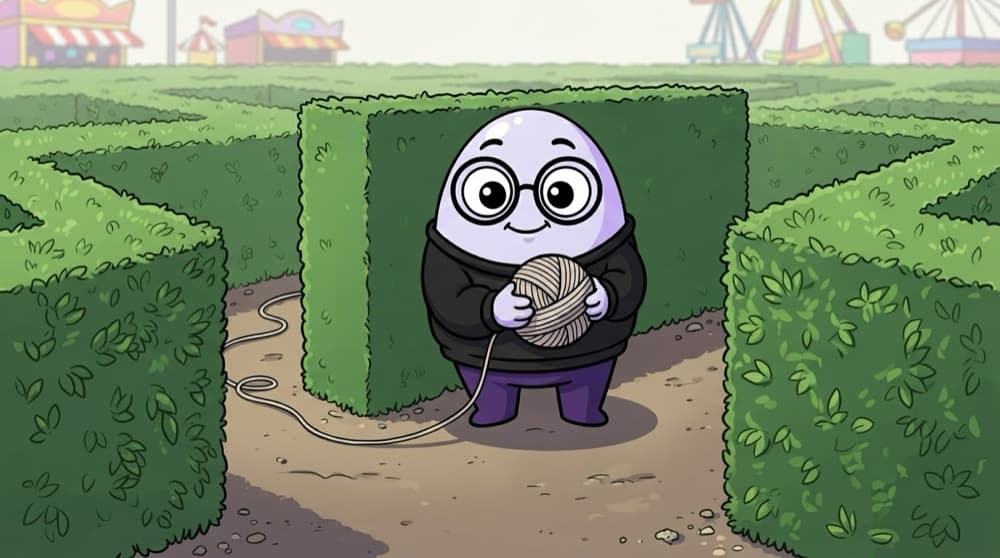
The hedge maze at a mela
In a mela maze you hold a ball of string. At each fork you pick a path and keep walking. Dead end? Wind the string back to the last fork and try the next turn. Walking deeper is recursion. Winding back and undoing your last choice is backtracking.
Watch it happen
Every subset of [a, b]
1/5First choice: take 'a'. The path is now [a]. Go one level deeper.
The big ideas
What you need to know
Base case first
Every recursive function needs a stopping point. Without it, Python raises RecursionError after about 1000 calls.
Each call is a fork
A recursive call is one choice at a fork. The call stack remembers where to come back to.
Choose, explore, undo
Backtracking adds a choice, recurses, then removes the choice so the next branch starts clean.
Prune early
If a partial answer already breaks a rule, return straight away. Pruning is what makes backtracking fast enough.
See it in code
Walk through the code
1def subsets(nums):2 result, path = [], []3 4 def backtrack(i):5 if i == len(nums): # base case: no choices left6 result.append(path[:])7 return8 path.append(nums[i]) # choose9 backtrack(i + 1) # explore with it10 path.pop() # undo11 backtrack(i + 1) # explore without it12 13 backtrack(0)14 return result15 16print(subsets(["a", "b"])) # [['a', 'b'], ['a'], ['b'], []]1/3Base case: every item is decided, so save a copy of the current path.
The take-or-skip template. Swap the base case and the choices and the same shape solves permutations, combination sum and word search.
Save yourself the pain
Common mistakes
Oops
Saving result.append(path) instead of a copy.
Do this instead
path keeps changing. Save path[:] or list(path), or every answer will end up as the same empty list.
Oops
Forgetting to undo the choice after the recursive call.
Do this instead
Every append before recursing needs a matching pop after it, so sibling branches don't see leftover choices.
Your mission
The backtracking trio
Quick check
Your subsets function returns [[], [], [], []] for [a, b]. What's the most likely bug?
Go deeper
- 1Write factorial and Fibonacci recursively and identify the base case.
- 2Generate all subsets of a small list with backtracking.
- 3Remember Python's default recursion limit and prefer loops for very deep problems.
Also part of these roadmaps
More topics at this stop
 Big-O Notation
 Arrays & Strings
 Hash Maps & Sets for Problem Solving
 Two Pointers & Sliding Window
 Stacks & Queues (deque)
 Linked Lists
 Sorting & Searching
 Trees & Graphs
 Heaps (heapq)
 Dynamic Programming Basics

Stuck on this topic? Ask an Insider
Get 1:1 guidance from people who've walked this exact path — on the InsideEdge app.
