
In short
Want the first five rows, the last three characters, every second item or a reversed copy? Slicing does all of it with one compact bracket syntax that works on lists, tuples and strings.
Slicing with [start:stop:step] pulls out part of a list, tuple or string. The stop index is excluded, missing values mean 'from the start' or 'to the end', and [::-1] reverses a sequence.
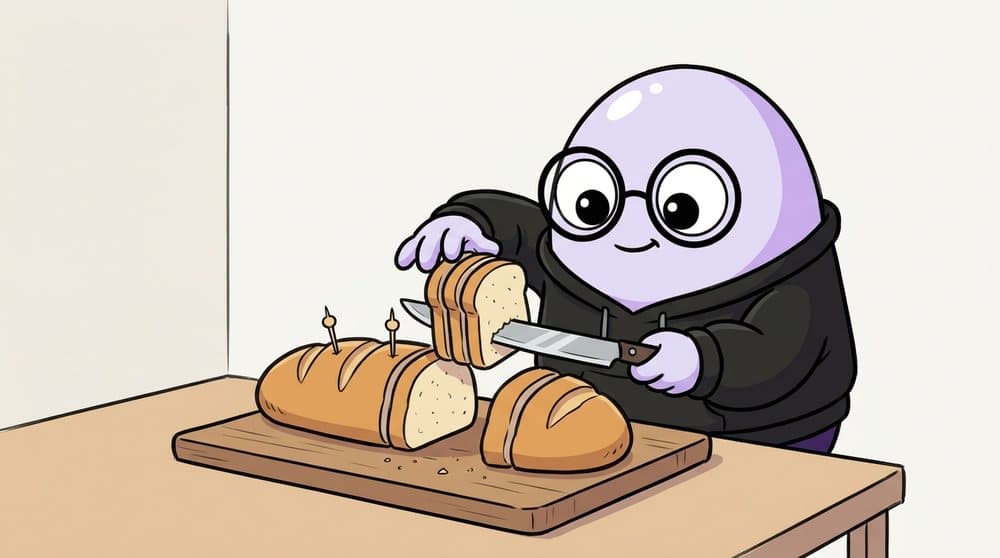
Think of it like this
Cutting slices from a loaf of bread
Mark where you start cutting and where you stop, and you get the slices in between. The stop mark is where the knife lands, so that slice isn't included. You could also take every second slice, or start from the end of the loaf. That's [start:stop:step].
Watch it happen
Slicing a list of seven days
1/6days[1:4] starts at index 1 and stops before index 4.
The big ideas
What you need to know
Stop is excluded
s[2:5] gives indexes 2, 3 and 4. The length of the slice is stop minus start.
Blanks mean the edge
A missing start means 0, a missing stop means the end. s[:] is a full shallow copy.
Negatives count from the end
-1 is the last item. s[-2:] gives the last two, and s[:-1] drops the last one.
Slices never crash
s[2:100] simply stops at the end. Plain indexing like s[100] raises IndexError, but slicing is forgiving.
See it in code
Walk through the code
1phone = "9876543210"2print(phone[:5]) # 987653print(phone[-4:]) # 32104print("XXXXXX" + phone[-4:]) # mask all but last 45 6scores = [45, 67, 89, 12, 90, 33, 71]7print(scores[2:5]) # [89, 12, 90]8print(scores[::2]) # [45, 89, 90, 71]9print(scores[::-1]) # reversed copy10 11word = "malayalam"12print(word == word[::-1]) # True, it's a palindrome13 14backup = scores[:] # a new list, not the same one15backup[0] = 016print(scores[0]) # still 451/4Strings slice too. [-4:] gives the last four digits, perfect for masking.
Masking a phone number, picking parts of a list, checking a palindrome and copying with [:].
Save yourself the pain
Common mistakes
Oops
Expecting nums[1:3] to include nums[3].
Do this instead
The stop index is never included. To get indexes 1 to 3, write nums[1:4].
Oops
Thinking s[::-1] reverses the original list.
Do this instead
Slicing always returns a new object. Use s.reverse() to reverse a list in place.
Your mission
PAN and date slicer
Quick check
What is 'PYTHONIC'[2:6]?
Go deeper
- 1Get the first three and last three items of a list with slices.
- 2Reverse a string with [::-1] and check if a word is a palindrome.
- 3Use a step of 2 to take every other item.
More topics at this stop
 Lists
 Tuples
 Dictionaries
 Sets
 Mutable vs Immutable & Copying
 Comprehensions (List, Dict, Set)
 Unpacking
 Choosing the Right Data Structure

Stuck on this topic? Ask an Insider
Get 1:1 guidance from people who've walked this exact path — on the InsideEdge app.
