
In short
When two classes share most of their code, copying it is a recipe for bugs. Inheritance lets a child class reuse a parent's code and change only what's different.
A child class inherits attributes and methods from a parent class and can override or extend them. super() calls the parent's version, most often inside __init__.
Think of it like this
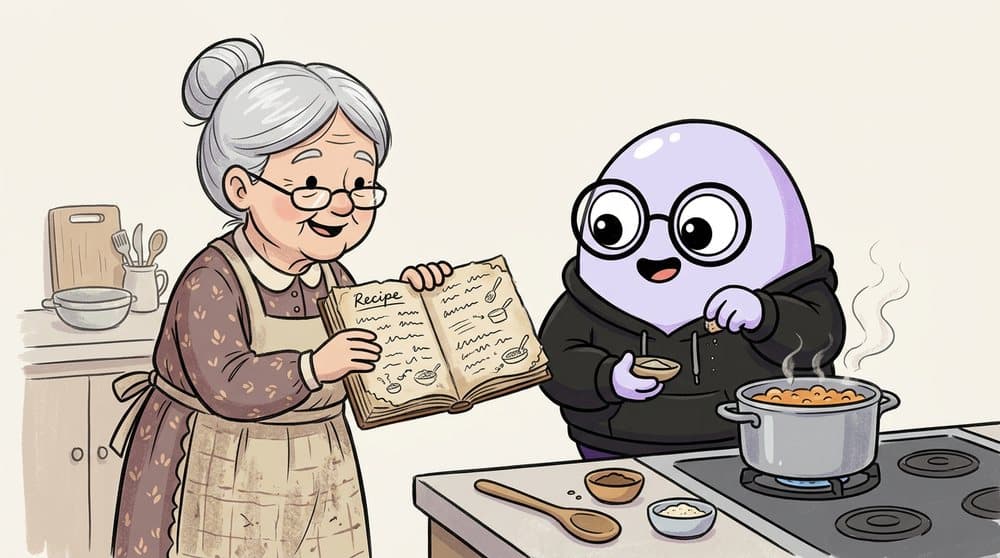
A family recipe passed down
Your grandmother's biryani recipe gets handed to your mother, who keeps it all but adds a pinch of kewra. Your mother doesn't rewrite the recipe from scratch; she uses Nani's steps and adds her own touch. super() is your mother saying 'first do it Nani's way, then add mine'.
Watch it happen
Employee family tree
1/4Employee has name, salary and a describe() method.
The big ideas
What you need to know
class Child(Parent)
The child gets every attribute and method of the parent automatically.
Override
Define a method with the same name in the child to change its behaviour for that child only.
super() reaches up
super().__init__(...) runs the parent's setup so you don't repeat it. Use it in any method to extend rather than replace.
Is-a, not has-a
Inherit only when the child truly is a kind of parent. A Car has an Engine, it isn't one, so use composition there.
See it in code
Walk through the code
1class Employee:2 def __init__(self, name: str, salary: float):3 self.name = name4 self.salary = salary5 6 def describe(self) -> str:7 return f"{self.name} earns Rs {self.salary:,.0f}"8 9 def annual_bonus(self) -> float:10 return self.salary * 0.1011 12class Manager(Employee):13 def __init__(self, name: str, salary: float, team_size: int):14 super().__init__(name, salary)15 self.team_size = team_size16 17 def describe(self) -> str:18 base = super().describe()19 return f"{base} and leads {self.team_size} people"20 21 def annual_bonus(self) -> float:22 return super().annual_bonus() + 1000 * self.team_size23 24m = Manager("Priya", 90000, 6)25print(m.describe()) # Priya earns Rs 90,000 and leads 6 people26print(m.annual_bonus()) # 15000.027print(isinstance(m, Employee)) # True1/6The parent sets up shared attributes.
A Manager reuses Employee's setup and methods, then extends them with team details.
Save yourself the pain
Common mistakes
Oops
Writing a child __init__ and forgetting to call super().__init__().
Do this instead
The parent's attributes never get set, leading to AttributeError later. Call super().__init__(...) first.
Oops
Building deep chains like A -> B -> C -> D -> E just to share one method.
Do this instead
Keep hierarchies shallow. Prefer composition or a helper function when classes aren't truly 'a kind of' each other.
Your mission
Vehicles of India
Quick check
What does super().__init__(name, salary) do inside Manager.__init__?
Go deeper
- 1Create a SavingsAccount that inherits from BankAccount and adds interest.
- 2Call super().__init__() so the parent sets up its attributes.
- 3Keep inheritance shallow and only use it for true 'is a' relationships.
Also part of these roadmaps
More topics at this stop
 Classes & Objects
 The __init__ Method & self
 Instance vs Class Attributes
 Instance, Class & Static Methods
 Polymorphism & Duck Typing
 Encapsulation & Properties
 Dunder (Magic) Methods
 Abstract Base Classes
 Dataclasses

Stuck on this topic? Ask an Insider
Get 1:1 guidance from people who've walked this exact path — on the InsideEdge app.
