Iterators & the Iterator Protocol
Part of the Python Roadmap
In short
for loops work on lists, strings, dicts, files and even database cursors. The reason is one tiny agreement called the iterator protocol, and once you see it, a lot of Python suddenly makes sense.
An iterable is anything you can loop over, and an iterator produces its items one at a time through __next__() until it raises StopIteration. for loops call iter() and next() for you behind the scenes.
Think of it like this
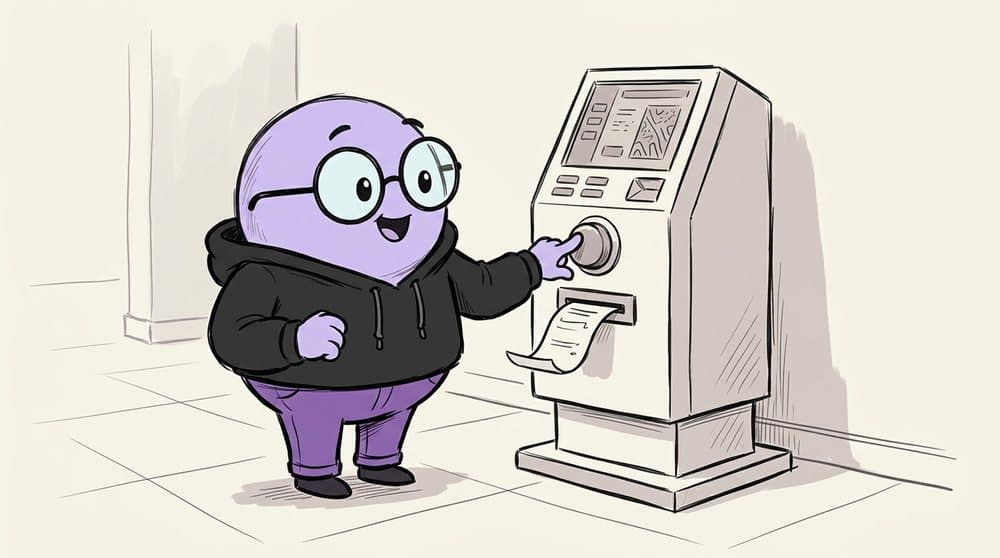
The token machine at the bank
The bank's token machine gives out one numbered slip each time you press the button: 1, 2, 3. It doesn't print all hundred tokens in the morning. When the day's tokens run out, it shows 'closed'. An iterator is that machine: next() gives the next item, and StopIteration means 'closed'.
Watch it happen
What a for loop over ['UPI', 'Card', 'Cash'] really does
1/5for calls iter(methods) once to get an iterator that remembers its position.
The big ideas
What you need to know
Iterable vs iterator
An iterable (list, str, dict) can give you an iterator with iter(). The iterator does the actual stepping with next().
Two methods
An iterator has __iter__ (returning itself) and __next__ (returning the next item or raising StopIteration).
One-time use
An iterator is used up after one pass. Call iter() on the original iterable again to restart.
Lazy
Iterators produce items on demand, so files, range() and zip() never need all their items in memory at once.
See it in code
Walk through the code
1methods = ["UPI", "Card", "Cash"]2it = iter(methods)3print(next(it)) # UPI4print(next(it)) # Card5print(next(it)) # Cash6# next(it) now raises StopIteration7 8class Countdown:9 def __init__(self, start: int):10 self.current = start11 12 def __iter__(self):13 return self14 15 def __next__(self) -> int:16 if self.current <= 0:17 raise StopIteration18 value = self.current19 self.current -= 120 return value21 22for n in Countdown(3):23 print(n) # 3, 2, 124 25nums = iter([1, 2, 3])26print(sum(nums)) # 627print(sum(nums)) # 0, already used up1/6iter() gives an iterator and each next() returns one item. After the last one, StopIteration.
Stepping through a list by hand, a custom Countdown iterator, and proof that iterators are one-time use.
Save yourself the pain
Common mistakes
Oops
Looping over the same iterator (like a zip or map object) twice and getting nothing the second time.
Do this instead
Convert it to a list if you need it more than once, or recreate it.
Oops
Returning None at the end of __next__ instead of raising StopIteration.
Do this instead
Returning None makes the loop run forever. Raise StopIteration to signal the end.
Your mission
Odd number iterator
Quick check
What signals the end of an iterator in Python?
Go deeper
- 1Call iter() and next() by hand on a list to see how a for loop works.
- 2Write a small class with __iter__ and __next__ that counts down.
- 3Notice that an iterator is used up after one full pass.
More topics at this stop
 Generators & yield
 Closures
 Decorators
 Type Hints
 The collections Module
 itertools & functools
 Regular Expressions (re)
 Dates & Times (datetime, zoneinfo)
 Writing Clean, Reusable Code

Stuck on this topic? Ask an Insider
Get 1:1 guidance from people who've walked this exact path — on the InsideEdge app.
