In short
Designers drag a button from the library. Developers import the same button from code. When both sides use one shared library, a new screen takes hours instead of days.
The actual reusable UI building blocks (buttons, inputs, cards) built from design tokens — the visible layer of a design system that designers actually drag onto a canvas.
Think of it like this
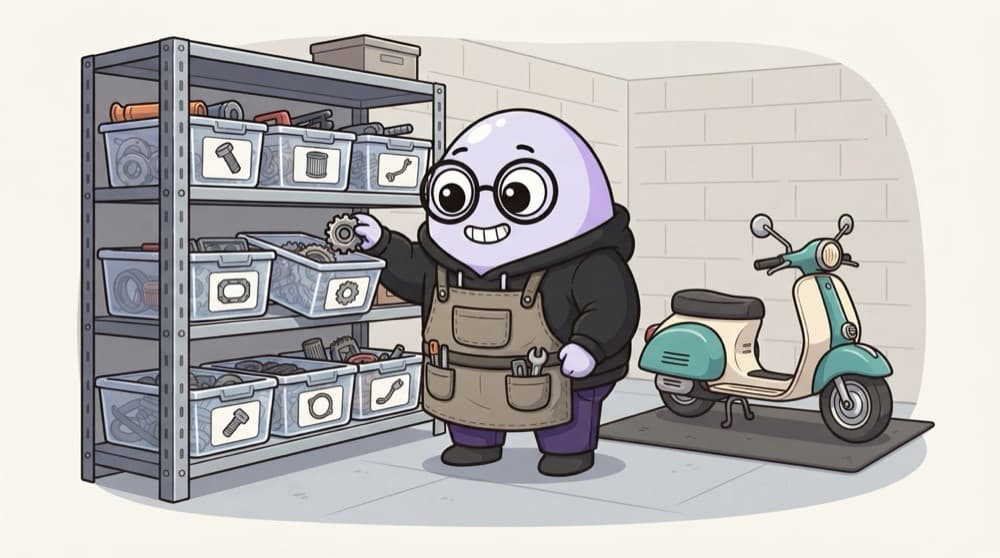
The mechanic's spare parts rack
A good garage doesn't build a new nut for every scooter. Parts sit on labelled shelves in standard sizes, ready to fit. A component library is that rack: tested buttons, inputs and cards, ready to drop into any screen.
Watch it happen
One Button component, many variants
1/4One main component called Button. Designers never draw a button from scratch again.
The big ideas
What you need to know
Main and instances
Edit the main component and every copy (instance) updates. Instances can still swap text or icons.
Properties, not copies
Use variant properties for type, size and state, instead of 30 separate button components.
Design and code match
The best libraries have the same component names and properties in Figma and in code.
All states included
A component isn't done until hover, focus, disabled, error and loading states are designed.
Save yourself the pain
Common mistakes
Oops
Detaching instances to make quick one-off changes.
Do this instead
Detached copies stop getting updates. Add a proper property or variant to the main component instead.
Oops
Making a component for everything, even things used once.
Do this instead
Componentise what repeats. A one-time hero banner doesn't need to live in the library.
Your mission
Build a button set
Quick check
You need a slightly different button on one screen. What's the best approach?
Go deeper
- 1Build a small component library (5-8 components) with consistent variants for a practice project.
- 2Learn to organize a component library file so it's easy to navigate and reuse.
- 3Practice building one component fully (all states, responsive behavior) rather than many half-finished ones.
More topics at this stop
 What Is a Design System
 Design Tokens
 Atomic Design Methodology
 Building a Design System in Figma
 Documentation for Design Systems
 Versioning & Governance
 Cross-Platform Design Systems
 Maintaining Design-Dev Consistency

Stuck on this topic? Ask an Insider
Get 1:1 guidance from people who've walked this exact path — on the InsideEdge app.
