In short
A function in JavaScript carries a little backpack of the variables around it. That backpack is a closure, and it powers counters, private data and a lot of how React hooks behave.
A closure is a function that remembers the variables from where it was created, even after that outer code has finished. It is how many counters, caches and event handlers keep private state.
Think of it like this
The dabbawala's code
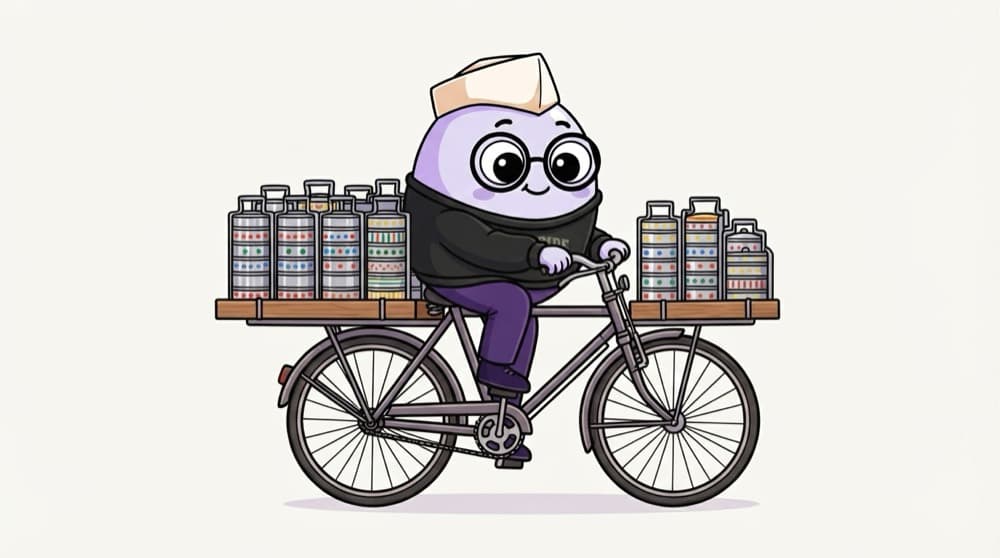
A dabbawala picks up your tiffin in the morning. Hours later, across the city, he still knows exactly whose it is because the code is painted on the lid. A closure is a function carrying its home's variables with it, long after it left home.
Watch it happen
The counter that remembers
let count = 0
1/6makeCounter runs and creates a variable called count.
The big ideas
What you need to know
Functions remember
A function keeps access to the variables of the place it was created, even after that outer function has finished.
It's a live link, not a copy
If the remembered variable changes, the function sees the new value. It doesn't freeze a snapshot.
Private state for free
Variables inside the outer function can't be touched from outside. Only the returned function can change them.
Each call makes a fresh backpack
Call the outer function twice and you get two separate closures with their own variables.
See it in code
Walk through the code
1function makeCounter() {2 let count = 0; // private, nobody outside can touch it3 return () => {4 count++;5 return count;6 };7}8 9const tapCounter = makeCounter();10console.log(tapCounter()); // 111console.log(tapCounter()); // 212 13const another = makeCounter();14console.log(another()); // 1 (its own separate count)1/4count is created inside makeCounter, so nothing outside can touch it.
makeCounter has finished running, yet count lives on because the returned arrow function still needs it. That surviving link is the closure.
Save yourself the pain
Common mistakes
Oops
Using var in a loop with setTimeout and getting the last value every time.
Do this instead
Use let. It creates a fresh variable for each loop round, so each callback remembers its own value.
Oops
Thinking a closure saves the value at the moment it was created.
Do this instead
It holds a reference to the variable. Change the variable later and the closure sees the change.
Your mission
Build a once() helper
Quick check
What does this log? for (var i = 0; i < 3; i++) setTimeout(() => console.log(i), 0);
Go deeper
- 1Build a makeCounter function that returns a function which counts up each time it is called.
- 2Explain closures in one sentence, as you would in an interview.
- 3Spot the closure in an event listener that uses a variable from outside it.
Also part of these roadmaps
More topics at this stop
 ES6+ Features
 Modules (import and export)
 Classes
 The this Keyword
 Error Handling
 Callbacks
 Promises
 Async/Await

Stuck on this topic? Ask an Insider
Get 1:1 guidance from people who've walked this exact path — on the InsideEdge app.
