In short
Tokenising text, cleaning a CSV column, reversing words: half of all coding rounds start with a plain array or string. Get fast here and every other topic feels lighter.
The most fundamental data structures — the majority of coding interview problems, including many ML-adjacent ones, reduce to array/string manipulation.
Think of it like this
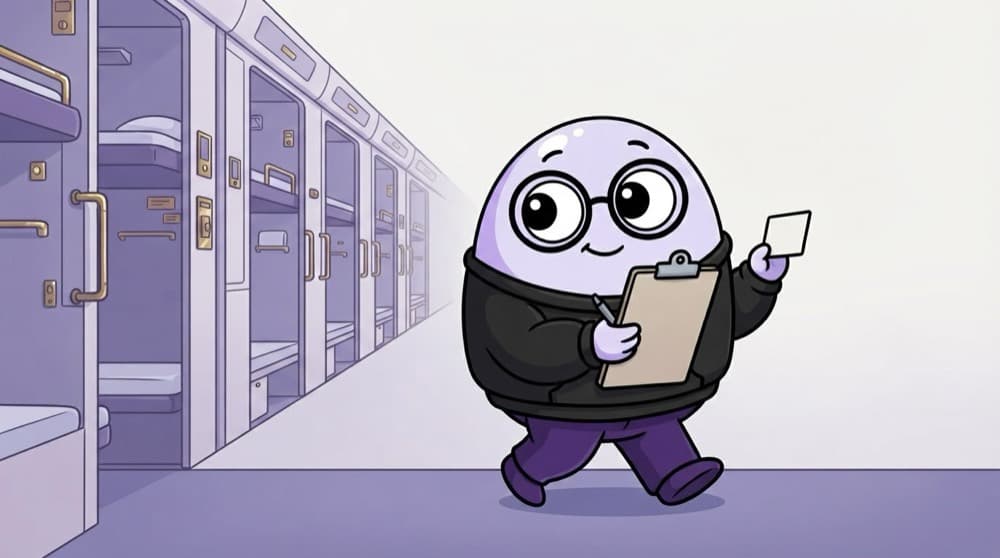
Berths in a sleeper coach
Berths in a coach sit in one straight line. The TT doesn't search the whole coach; he walks straight to berth 37. That's array indexing. But if a new passenger must squeeze in at berth 5, everyone after has to shift one place. That's why inserting in the middle is slow.
Watch it happen
Two pointers check "racecar"
1/4Put one pointer at each end. Compare s[0] and s[6]: both 'r'. Match.
The big ideas
What you need to know
Index access is instant
arr[i] jumps straight to slot i in O(1) time, because items sit side by side in memory.
Middle inserts are slow
Inserting or deleting near the front shifts every later item, so it costs O(n). Appending at the end is cheap.
Python strings can't change
Strings are immutable. Building one with += in a loop copies it again and again; collect parts in a list and "".join them.
Learn the patterns
Two pointers, prefix sums and counting with a dict solve a surprising number of array and string questions.
See it in code
Walk through the code
1def is_palindrome(s: str) -> bool:2 left, right = 0, len(s) - 13 while left < right:4 if not s[left].isalnum():5 left += 16 elif not s[right].isalnum():7 right -= 18 elif s[left].lower() != s[right].lower():9 return False10 else:11 left += 112 right -= 113 return True14 15print(is_palindrome("Race car")) # True1/4Start one pointer at each end of the string.
Classic two pointers: O(n) time and O(1) extra space. It skips spaces and punctuation and ignores case, which interviewers love to ask about.
Save yourself the pain
Common mistakes
Oops
Building a long string with result += ch inside a loop.
Do this instead
Append pieces to a list and call "".join(parts) once at the end. It avoids copying the string every time.
Oops
Jumping into code and getting the last index wrong.
Do this instead
Say the boundaries out loud first: is right len(s) - 1 or len(s)? Test with an empty string and a single character.
Your mission
Four warm-up problems
Quick check
You call list.insert(0, x) on a Python list with a million items. Roughly how much work is that?
Go deeper
- 1Practice two-pointer and prefix-sum patterns on array problems.
- 2Solve string-manipulation problems (substrings, palindromes, anagrams).
- 3Aim for clean, bug-free code on easy problems before moving to medium difficulty.
More topics at this stop
 HashMap
 Trees & Graphs
 Dynamic Programming
 Recursion & Backtracking
 Sorting & Searching
 Sliding Window
 Heaps

Stuck on this topic? Ask an Insider
Get 1:1 guidance from people who've walked this exact path — on the InsideEdge app.
