In short
Folders on your laptop, a decision tree model, the links between people on LinkedIn: all trees and graphs. Interviewers use them to see if you can walk a structure without getting lost.
Hierarchical and networked data structures — core to interview problems and directly relevant to real structures like model architectures and knowledge graphs.
Think of it like this
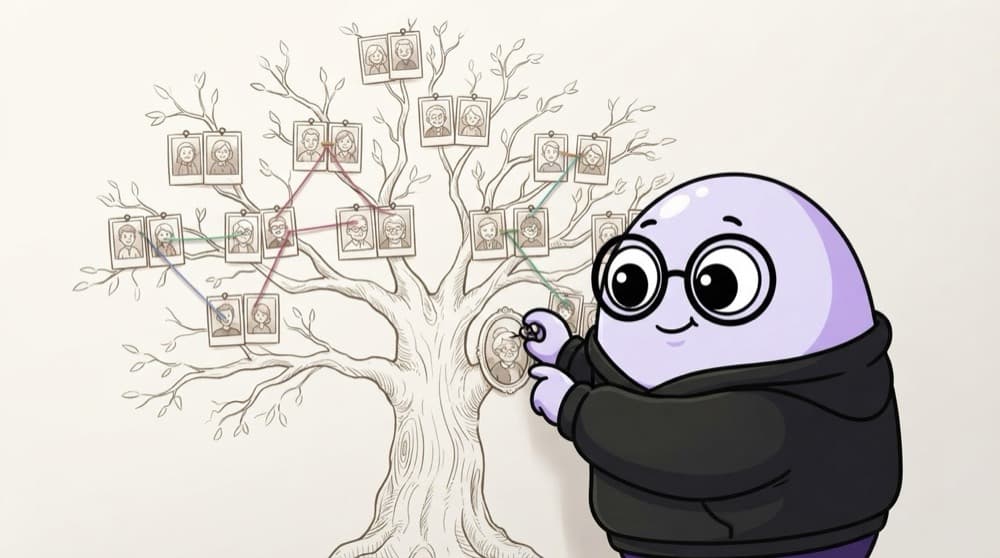
The family tree at a wedding
At a big Indian wedding, aunties explain everyone with a family tree: Dadaji at the top, then his children, then grandchildren. That's a tree, every person has one parent line. Then you learn your cousin's friend is also your neighbour's nephew. Once links go sideways and loop around, it's a graph.
Watch it happen
Breadth-first: one generation at a time
1/4BFS starts at the root and puts it in a queue. Level 0 is just Dadaji.
The big ideas
What you need to know
A tree is a graph without loops
One root, every node has exactly one parent. Graphs allow any links, including cycles.
Store graphs as adjacency lists
A dict from each node to its neighbours. Compact, and easy to loop over.
BFS for shortest hops
BFS uses a queue and visits level by level, so it finds the fewest-hops path in an unweighted graph.
DFS for exploring everything
DFS goes deep with recursion or a stack. Good for cycles, connected parts and tree depth.
See it in code
Walk through the code
1from collections import deque2 3graph = {"A": ["B", "C"], "B": ["A", "D"], "C": ["A", "D"], "D": ["B", "C", "E"], "E": ["D"]}4def bfs(start):5 visited, order = {start}, []6 queue = deque([start])7 while queue:8 node = queue.popleft()9 order.append(node)10 for nxt in graph[node]:11 if nxt not in visited:12 visited.add(nxt)13 queue.append(nxt)14 return order15 16print(bfs("A")) # ['A', 'B', 'C', 'D', 'E']1/4The graph as a dict: each node maps to the list of its neighbours.
BFS on an adjacency list touches each node and edge once, so it runs in O(V + E). The visited set stops it looping between A and B forever.
Save yourself the pain
Common mistakes
Oops
Forgetting the visited set on a graph because the tree version didn't need one.
Do this instead
Trees can't loop, graphs can. Always track visited nodes in a graph, or you'll circle A to B to A forever.
Oops
Using a Python list and list.pop(0) as the BFS queue.
Do this instead
pop(0) shifts the whole list each time. Use collections.deque and popleft(), which is O(1).
Your mission
Walk three structures
Quick check
You need the fewest connections between two people in a friend network. Which traversal fits?
Go deeper
- 1Practice DFS and BFS traversal on both trees and graphs until they're automatic.
- 2Solve tree problems: depth, balance, path sum, lowest common ancestor.
- 3Solve graph problems: connected components, shortest path, cycle detection.
More topics at this stop
 Arrays & Strings
 HashMap
 Dynamic Programming
 Recursion & Backtracking
 Sorting & Searching
 Sliding Window
 Heaps

Stuck on this topic? Ask an Insider
Get 1:1 guidance from people who've walked this exact path — on the InsideEdge app.
