
Recursion & Backtracking
Part of the AI Engineer Roadmap
In short
Generate every subset, solve a Sudoku, place N queens: these sound scary until you see they're one small pattern. Choose, explore, undo. Learn it once and a whole family of questions opens up.
Solving problems by having a function call itself on smaller subproblems, with backtracking exploring and undoing choices to search a solution space.
Think of it like this
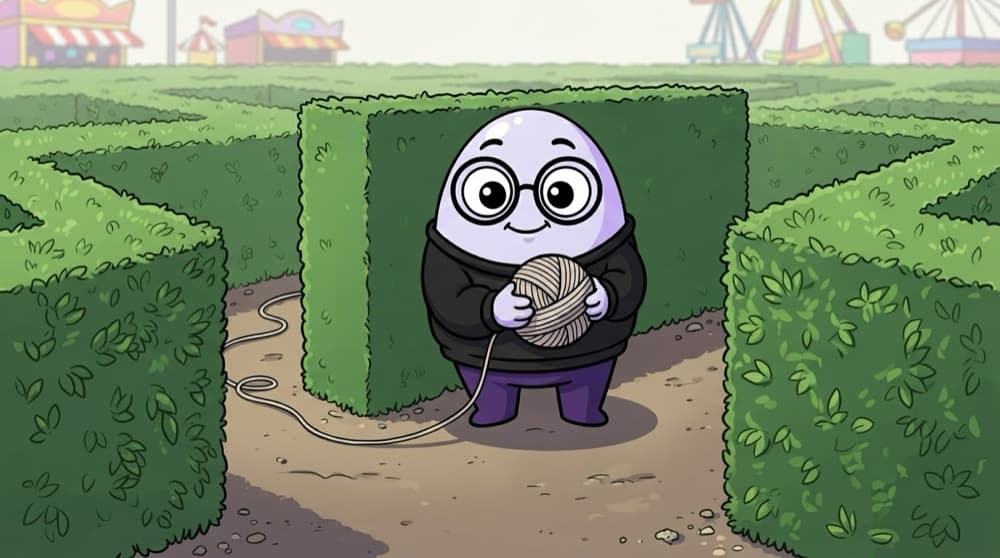
The hedge maze at a mela
In a mela maze you hold a ball of string. At each fork you pick a path and keep walking. Dead end? Wind the string back to the last fork and try the next turn. Walking deeper is recursion. Winding back and undoing your last choice is backtracking.
Watch it happen
Every subset of [a, b]
1/5First choice: take 'a'. The path is now [a]. Go one level deeper.
The big ideas
What you need to know
Base case first
Every recursive function needs a stopping point. Without it, Python raises RecursionError after about 1000 calls.
Each call is a fork
A recursive call is one choice at a fork. The call stack remembers where to come back to.
Choose, explore, undo
Backtracking adds a choice, recurses, then removes the choice so the next branch starts clean.
Prune early
If a partial answer already breaks a rule, return straight away. Pruning is what makes backtracking fast enough.
See it in code
Walk through the code
1def subsets(nums):2 result, path = [], []3 4 def backtrack(i):5 if i == len(nums): # base case: no choices left6 result.append(path[:])7 return8 path.append(nums[i]) # choose9 backtrack(i + 1) # explore with it10 path.pop() # undo11 backtrack(i + 1) # explore without it12 13 backtrack(0)14 return result15 16print(subsets(["a", "b"])) # [['a', 'b'], ['a'], ['b'], []]1/3Base case: every item is decided, so save a copy of the current path.
The take-or-skip template. Swap the base case and the choices and the same shape solves permutations, combination sum and word search.
Save yourself the pain
Common mistakes
Oops
Saving result.append(path) instead of a copy.
Do this instead
path keeps changing. Save path[:] or list(path), or every answer will end up as the same empty list.
Oops
Forgetting to undo the choice after the recursive call.
Do this instead
Every append before recursing needs a matching pop after it, so sibling branches don't see leftover choices.
Your mission
The backtracking trio
Quick check
Your subsets function returns [[], [], [], []] for [a, b]. What's the most likely bug?
Go deeper
- 1Practice classic backtracking problems: permutations, subsets, combinations.
- 2Learn to identify the base case and recursive case clearly before coding.
- 3Trace recursion trees by hand for a few problems to build intuition.
More topics at this stop
 Arrays & Strings
 HashMap
 Trees & Graphs
 Dynamic Programming
 Sorting & Searching
 Sliding Window
 Heaps

Stuck on this topic? Ask an Insider
Get 1:1 guidance from people who've walked this exact path — on the InsideEdge app.
