In short
When a service you depend on is down, hammering it with retries only makes things worse for both of you. A circuit breaker stops calling, fails fast, and checks back later.
A pattern that stops calling a failing downstream service after repeated failures, failing fast instead of piling up slow, doomed requests — preventing one failing service from cascading into a system-wide outage.
Think of it like this
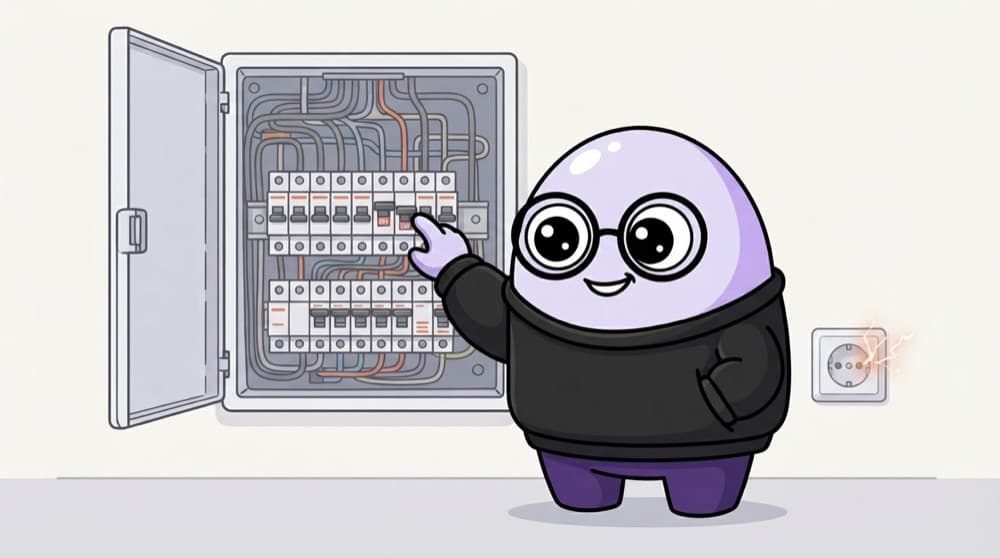
The MCB in your house
When a faulty heater shorts, the MCB trips and cuts power to that circuit before the wiring burns. You don't keep flicking the switch. Later you push the MCB back up to test. If it trips again, the heater's still faulty. A circuit breaker in code works exactly like this.
Watch it happen
The three breaker states
1/5Closed: calls flow to the payments service normally, and the breaker counts failures.
The big ideas
What you need to know
Fail fast
When open, calls return an error or fallback straight away instead of waiting for a timeout. Your server stays responsive.
Have a fallback
Show cached prices, queue the order for later, or show a clear 'try again'. Anything beats hanging.
Timeouts first
A breaker counts failures, and a call with no timeout never fails, it just hangs. Always set timeouts.
Watch the state
Log or graph state changes. An open breaker is an early alarm that a dependency is unhealthy.
See it in code
Walk through the code
1import CircuitBreaker from "opossum";2 3async function chargeCard(orderId: string) {4 const res = await fetch(`http://payments/charge/${orderId}`, { method: "POST" });5 if (!res.ok) throw new Error(`payments ${res.status}`);6 return res.json();7}8 9const breaker = new CircuitBreaker(chargeCard, {10 timeout: 2000, // slower than 2 s counts as a failure11 errorThresholdPercentage: 50, // open when half the calls fail12 resetTimeout: 30_000, // try again after 30 s13});14breaker.fallback(() => ({ status: "queued" }));15breaker.on("open", () => logger.warn("payments breaker OPEN"));16const result = await breaker.fire("order_981");1/4Wrap the risky call and set the timeout, failure threshold and cool-down.
opossum is a popular circuit breaker library for Node. Service meshes like Istio can apply the same idea outside your code.
Save yourself the pain
Common mistakes
Oops
Retrying failed calls immediately in a tight loop.
Do this instead
That multiplies load on a struggling service. Retry a few times with backoff and jitter, behind a breaker.
Oops
One breaker shared by every downstream service.
Do this instead
Payments failing would then block emails too. Use one breaker per dependency.
Your mission
Trip a breaker
Quick check
The breaker is open. What happens to a new call?
Go deeper
- 1Diagram the three circuit breaker states: closed, open, half-open.
- 2Implement a basic circuit breaker around a flaky external API call.
- 3Understand this pattern specifically prevents cascading failures across services.
More topics at this stop
 Scalability Basics
 Vertical vs Horizontal Scaling
 Load Balancing
 Database Replication
 Database Sharding
 CAP Theorem
 Microservices vs Monolith
 API Gateway
 Service Discovery
 Distributed Caching
 Consistent Hashing
 Rate Limiting Algorithms
 Designing a URL Shortener
 Designing a Rate Limiter

Stuck on this topic? Ask an Insider
Get 1:1 guidance from people who've walked this exact path — on the InsideEdge app.
