Terraform Modules
Part of the Cloud Computing Roadmap
In short
Your dev, staging and prod networks are 90% the same code, copied three times. Fix a bug in one, forget the others. Modules let you write it once and reuse it.
Reusable, parameterized bundles of Terraform configuration — avoiding copy-pasted infrastructure code across environments (dev/staging/prod) the same way functions avoid copy-pasted application code.
Think of it like this
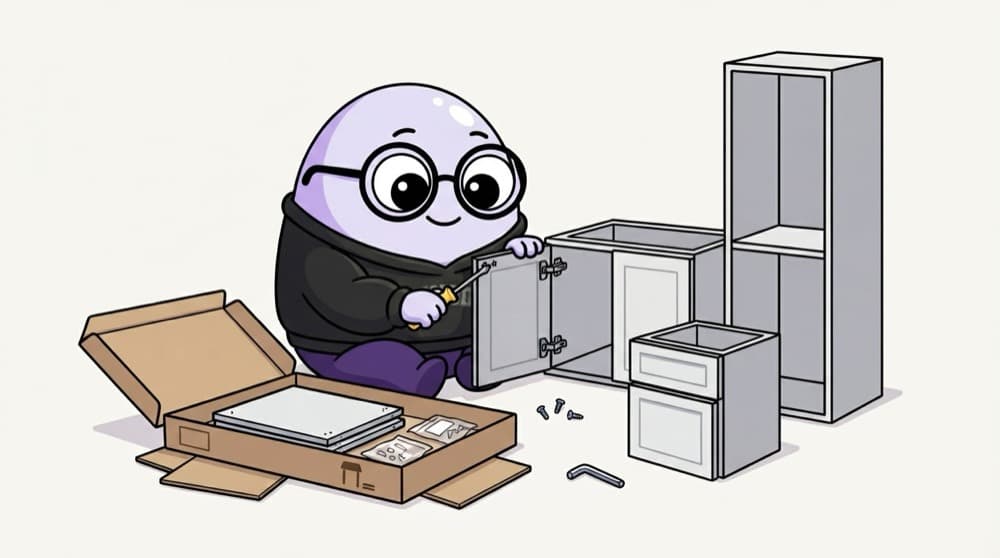
The modular kitchen kit
Modular kitchen makers don't design every cabinet from scratch. They have one tested unit that comes in small, medium and large, with the same hinges and fittings. A Terraform module is that unit: one tested design, with inputs for size and colour.
Watch it happen
A root module calling two child modules
1/4The root module is the folder you run Terraform in, here envs/prod. It mostly just calls modules.
The big ideas
What you need to know
A module is a folder
Any folder of .tf files is a module. It has inputs (variables), resources inside and outputs.
Inputs, not copies
Environments differ only in the values they pass: instance size, CIDR range, replica count.
Pin versions
When calling a module from Git or the Terraform Registry, pin a version so an upstream change doesn't surprise you.
Keep them focused
A module should do one job well, like 'a network' or 'a web service', not 'all of production'.
See it in code
Walk through the code
1module "web" {2 source = "./modules/web-server"3 env = "prod"4 instance_type = "t3.small"5 min_size = 26}7 8output "web_url" {9 value = module.web.url10}1/3Call a module from a local folder. It could also be a Git URL or a Registry address with a version.
The modules/web-server folder must declare variables named env, instance_type and min_size, and an output named url.
Save yourself the pain
Common mistakes
Oops
Building one giant module with fifty variables for every possible case.
Do this instead
Make small modules with a few clear inputs. If a module needs many if-else flags, it's probably two modules.
Oops
Using a public module from the Registry without reading its code.
Do this instead
Read what it creates and pin the version. You're responsible for every resource it adds to your account.
Your mission
Write your first module
Quick check
Dev and prod need the same network setup with different CIDR ranges. What's the cleanest approach?
Go deeper
- 1Refactor a Terraform configuration into a reusable module with input variables.
- 2Use your module to provision the same infrastructure pattern twice with different parameters.
- 3Explore a public Terraform module registry for well-tested, community-maintained modules.
More topics at this stop
 IaC Concepts & Benefits
 Terraform Fundamentals
 CloudFormation / ARM Templates / Deployment Manager
 Terraform State Management
 Configuration Management (Ansible Overview)
 CI/CD for Cloud Deployments
 GitOps Basics
 IaC Testing & Validation

Stuck on this topic? Ask an Insider
Get 1:1 guidance from people who've walked this exact path — on the InsideEdge app.
