
Explain a Past Infrastructure Project
Part of the DevOps Roadmap
In short
'Tell me about a project you're proud of' is asked in nearly every interview. A clear, five-minute story about something you built can carry the whole round, even for a fresher.
Walking an interviewer through a real project (from your portfolio or work) — the problem, your approach, what you built, and its impact — one of the most predictable interview questions.
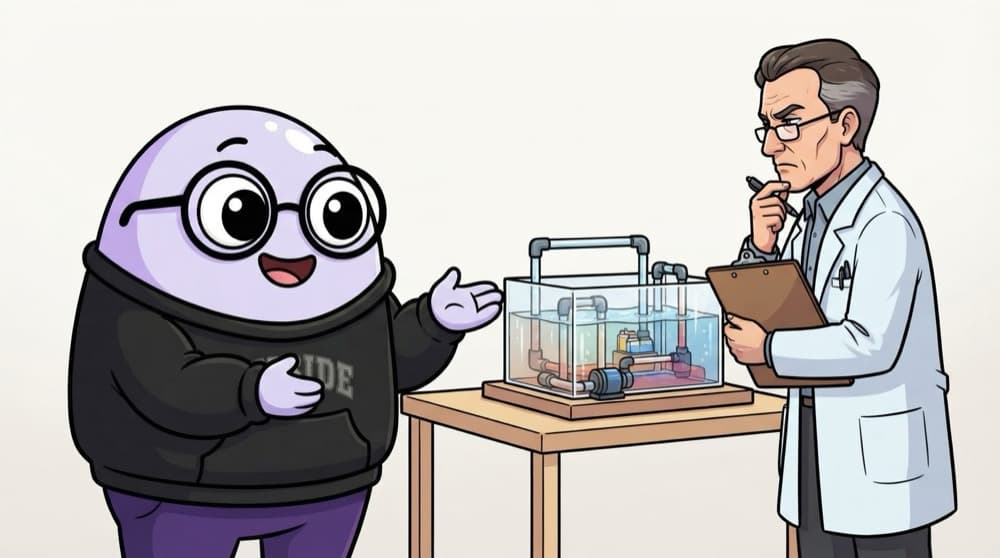
Think of it like this
The science fair judge
At a science fair, the judge has two minutes per table. The students who win say what problem they picked, how their model works, what they measured and what they'd improve. The ones who just list parts don't. Your project story needs that same shape.
Watch it happen
Shape of a strong project story
1/5One or two lines: 'For my final-year project, our team of four built a food ordering app for the college canteen.'
The big ideas
What you need to know
Say 'I', not just 'we'
Interviewers need to know what you did. Credit the team, then be specific about your own part.
Explain one trade-off
'We chose ECS over Kubernetes because it was simpler for four people' shows real decision making.
Use real numbers
Minutes saved, cost reduced, uptime improved. Only use numbers you can explain; made-up ones fall apart on follow-ups.
Have a diagram ready
A simple architecture diagram in your GitHub README lets you point and explain in an online interview.
Save yourself the pain
Common mistakes
Oops
Listing every tool used: 'Docker, Jenkins, Terraform, Ansible, Grafana, Kubernetes...'
Do this instead
Pick the two or three that mattered and explain why. Depth on a few beats a long list of names.
Oops
Choosing the biggest project, even though you only did a small part of it.
Do this instead
Pick the one where you can answer deep follow-up questions. Ownership matters more than size.
Your mission
Write and rehearse your story
Quick check
Which part of a project story is most often missing in weak answers?
Go deeper
- 1Prepare a tight 2-3 minute walkthrough of your strongest Phase 14 portfolio project.
- 2Structure it as: problem, architecture decisions, implementation, outcome — in that order.
- 3Practice fielding a technical follow-up question about a specific design choice.
More behavioral at this stop
 Handling a Production Incident
 Cross-Team Collaboration Stories
 Staying Current With DevOps Tools

Stuck on this topic? Ask an Insider
Get 1:1 guidance from people who've walked this exact path — on the InsideEdge app.
