In short
First come, first served. Queues power task schedulers, print jobs and, most importantly for interviews, breadth-first search on trees and graphs.
A First-In-First-Out (FIFO) data structure — the natural fit for breadth-first traversal, task scheduling, and processing items in arrival order.
Think of it like this
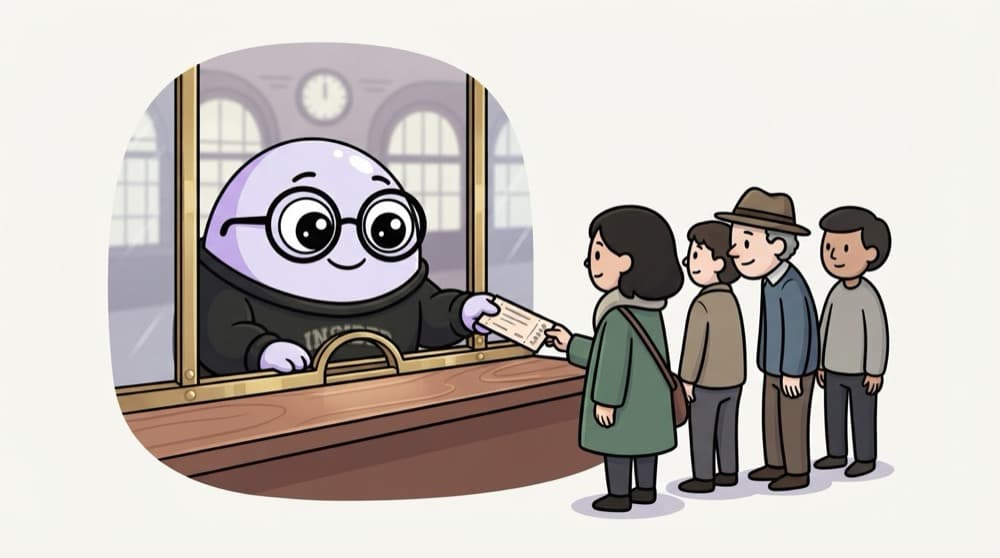
The railway ticket counter line
New people join at the back, and the clerk serves whoever is at the front. Nobody jumps the line (in theory). That's FIFO: first in, first out.
Watch it happen
First in, first out with a head index
Front of the queue is coloured
1/6enqueue(A): A joins at the back. head is 0.
The big ideas
What you need to know
Add at the back, remove at the front
enqueue adds to the rear, dequeue takes from the front. Both should be O(1).
array.shift() is not free
shift moves every remaining item forward, so it's O(n). Fine for small inputs, slow for huge ones.
Use a head index
Keep the array and just move a head pointer forward. Dequeue becomes O(1).
Queues drive BFS
Breadth-first search visits things level by level, and a queue keeps that order for you.
See it in code
Walk through the code
1class Queue {2 constructor() {3 this.items = [];4 this.head = 0;5 }6 enqueue(x) { this.items.push(x); }7 dequeue() {8 if (this.head === this.items.length) return undefined;9 return this.items[this.head++];10 }11 get size() { return this.items.length - this.head; }12}1/4A plain array plus a head index that marks the front.
dequeue just reads at head and moves the index, so both operations are O(1). The trade-off: old items aren't freed until you reset the array.
Save yourself the pain
Common mistakes
Oops
Calling shift() inside a BFS over a grid with lakhs of cells.
Do this instead
Use a head index, or swap the queue for a fresh array each level.
Oops
Mixing up stack and queue when doing level-order traversal.
Do this instead
A queue gives level order (BFS). A stack gives depth-first order (DFS).
Your mission
Queue drills
Quick check
You enqueue A, B, C, then dequeue twice. What's left in the queue?
Go deeper
- 1Implement a queue from scratch and compare its operations to a stack's.
- 2Use a queue to implement breadth-first search (BFS) on a graph or tree.
- 3Learn about circular queues and deques (double-ended queues) as variants.
More topics at this stop
 Arrays
 Strings
 Linked List
 Stack
 HashMap
 Heap
 Tree
 Graph
 Binary Search
 Recursion
 Backtracking
 Sliding Window
 Greedy
 Dynamic Programming
 Sorting
 Searching

Stuck on this topic? Ask an Insider
Get 1:1 guidance from people who've walked this exact path — on the InsideEdge app.
