
In short
The DOM you've been styling all along is a tree. Tree questions test recursion more than anything else, so once recursion clicks, most of them follow one template.
A hierarchical data structure of nodes with parent-child relationships — binary trees and BSTs are a huge, recurring category in interviews.
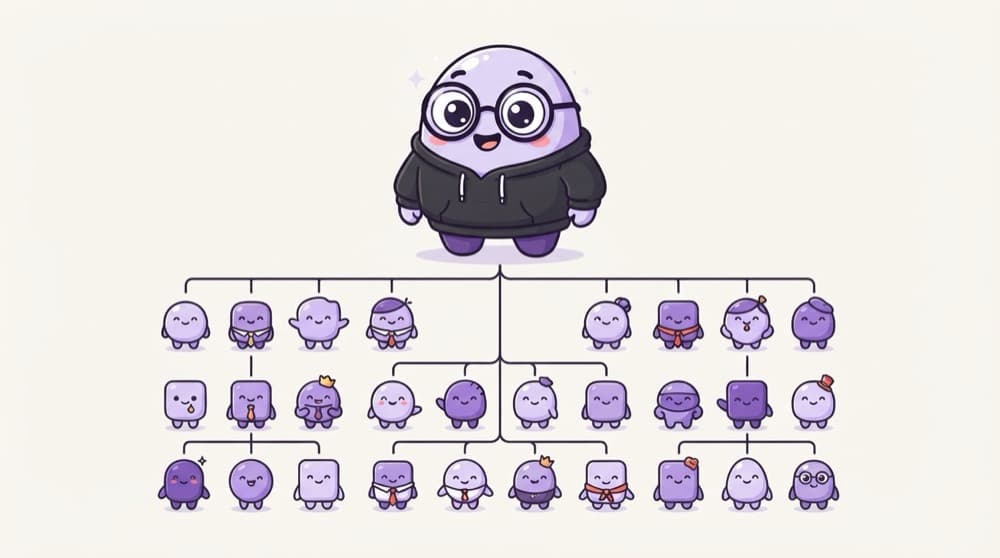
Think of it like this
Your college's org chart
The principal is at the top. Under them are HODs, and under each HOD are professors. Ask 'how many people in total?' and each HOD counts their own team and reports up. Trees work exactly like that.
Watch it happen
maxDepth on a small BST
1/6maxDepth(8) starts. It must ask both children before it can answer.
The big ideas
What you need to know
Root, children, leaves
One root at the top. Each node can have children. Nodes with no children are leaves.
Every subtree is a tree
So most answers are: solve for the left subtree, solve for the right, combine.
BST keeps things ordered
In a Binary Search Tree, left is smaller and right is bigger, so search is O(h), where h is height.
DFS vs BFS
DFS (recursion) goes deep down one branch first. BFS (a queue) goes level by level.
See it in code
Walk through the code
1// node: { val, left, right }2function maxDepth(node) {3 if (!node) return 0;4 const left = maxDepth(node.left);5 const right = maxDepth(node.right);6 return 1 + Math.max(left, right);7}1/3Base case: an empty spot adds no depth.
Each node is visited once, so time is O(n). Stack space is O(h): O(log n) if balanced, O(n) if the tree is one long chain.
Save yourself the pain
Common mistakes
Oops
Assuming a BST search is always O(log n).
Do this instead
That's only for a balanced tree. Insert sorted data into a plain BST and it becomes a chain with O(n) search.
Oops
Forgetting the null check and crashing on node.left of undefined.
Do this instead
Write the base case first, before anything else in a tree function.
Your mission
Tree trio
Quick check
You insert 1, 2, 3, 4, 5 in that order into an empty BST (no balancing). How long does searching for 5 take?
Go deeper
- 1Implement tree traversals: inorder, preorder, postorder, and level-order (BFS).
- 2Solve classic problems: max depth, validate a BST, lowest common ancestor.
- 3Practice both recursive and iterative traversal implementations.
More topics at this stop
 Arrays
 Strings
 Linked List
 Stack
 Queue
 HashMap
 Heap
 Graph
 Binary Search
 Recursion
 Backtracking
 Sliding Window
 Greedy
 Dynamic Programming
 Sorting
 Searching

Stuck on this topic? Ask an Insider
Get 1:1 guidance from people who've walked this exact path — on the InsideEdge app.
