In short
Your browser's back button, Ctrl+Z and the JS call stack all work the same way. Whenever a problem says 'matching' or 'nested', think stack first.
A Last-In-First-Out (LIFO) data structure — used for problems involving nested or matching structures, undo functionality, and backtracking.

Think of it like this
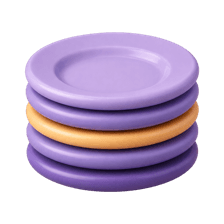
Plates in the hostel mess
Washed plates go on top of the pile, and the next student takes the top one. The plate that went in last comes out first. Nobody pulls a plate from the bottom.
Watch it happen
Checking "{[()]}"
Top of the stack is coloured
1/6'{' is an opener, so push it on the stack.
The big ideas
What you need to know
Last in, first out
You only touch the top: push adds, pop removes, peek looks. All are O(1).
A JS array is enough
Use push and pop on a normal array. They work at the end, which is fast.
Great for matching pairs
Brackets, HTML tags, undo history. The most recent open thing must close first.
Monotonic stack
Keep the stack sorted to answer 'next greater element' style questions in O(n).
See it in code
Walk through the code
1function isValid(s) {2 const pairs = { ")": "(", "]": "[", "}": "{" };3 const stack = [];4 5 for (const ch of s) {6 if (ch in pairs) {7 if (stack.pop() !== pairs[ch]) return false;8 } else {9 stack.push(ch);10 }11 }12 return stack.length === 0;13}14 15isValid("{[()]}"); // true1/4A lookup from each closer to its opener, plus an empty stack.
One pass over the string, so time is O(n). In the worst case, like "((((", every character sits on the stack, so space is O(n).
Save yourself the pain
Common mistakes
Oops
Returning true as soon as the loop ends.
Do this instead
Check the stack is empty. "(((" never fails a match but is still unbalanced.
Oops
Using shift and unshift to build a stack.
Do this instead
Work at the end with push and pop. The front of an array is the slow side.
Your mission
Stack it up
Quick check
You push 1, 2, 3 onto a stack, pop once, then push 4. What does the next pop return?
Go deeper
- 1Solve the classic 'valid parentheses' problem using a stack.
- 2Implement a stack from scratch using an array.
- 3Recognize stack-shaped problems: anything about matching, nesting, or 'most recent unresolved item'.
More topics at this stop
 Arrays
 Strings
 Linked List
 Queue
 HashMap
 Heap
 Tree
 Graph
 Binary Search
 Recursion
 Backtracking
 Sliding Window
 Greedy
 Dynamic Programming
 Sorting
 Searching

Stuck on this topic? Ask an Insider
Get 1:1 guidance from people who've walked this exact path — on the InsideEdge app.
