In short
"Design a parking lot" or "design BookMyShow" in 45 minutes. LLD rounds check whether your Java classes are clean, extensible and sensible, which is exactly what you'll write every day on the job.
Low-level design rounds ask you to design classes for systems like a parking lot, library or BookMyShow-style booking in Java. Interviewers check your use of OOP, SOLID, design patterns and clean method contracts.
Think of it like this
The mall parking manager
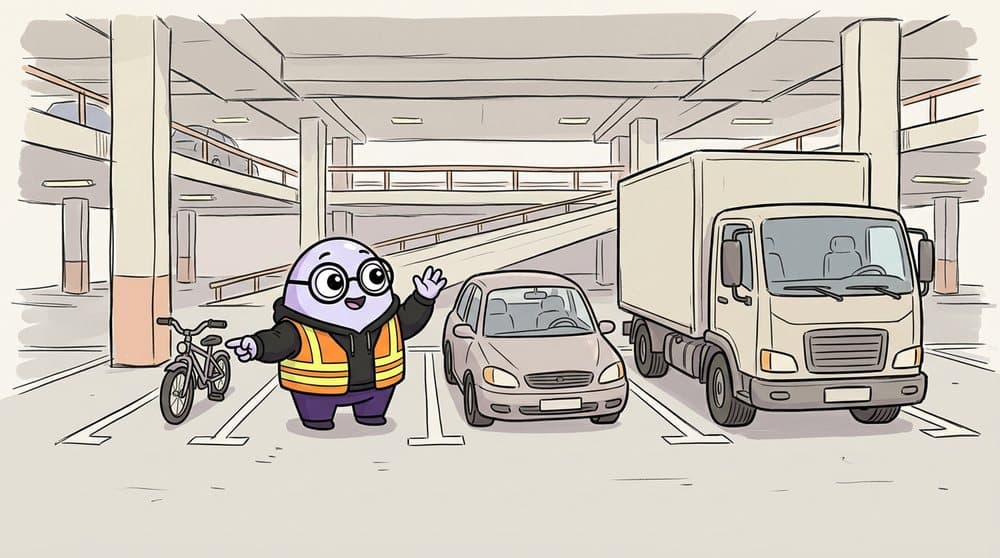
The parking manager at a big mall in Gurugram thinks in parts: floors, spots of different sizes, vehicles, tickets, payment counters. Each part has a clear job, and adding EV charging spots next year shouldn't mean rebuilding the whole basement. That's what interviewers want from your class design.
The big ideas
What you need to know
SOLID
Single responsibility, open/closed, Liskov, interface segregation, dependency inversion. Name them when your design follows them.
Useful patterns
Strategy for pricing, Factory for creating vehicles or spots, Singleton sparingly, Observer for notifications.
Enums and interfaces
Use enums for fixed types like SpotSize, and interfaces where behaviour varies.
Concurrency
Mention how you'd stop two threads from booking the same spot or seat, for example with synchronized or a database lock.
How it works
A repeatable way to answer
- 1
Clarify
Ask about vehicle types, number of floors, payment, and what's out of scope.
- 2
Nouns to classes
ParkingLot, Floor, Spot, Vehicle, Ticket, PricingStrategy.
- 3
Relationships
A lot has floors, a floor has spots, a ticket links a vehicle to a spot.
- 4
Key methods
park(vehicle) returns a Ticket, unpark(ticket) returns the fee.
- 5
Extend and discuss
Patterns used, thread safety for two cars taking the same spot, and how to add new vehicle types.
See it in code
Walk through the code
1import java.time.*;2import java.util.*;3 4enum SpotSize { SMALL, MEDIUM, LARGE }5 6sealed interface Vehicle permits Bike, Car, Truck {7 String number();8 SpotSize needs();9}10record Bike(String number) implements Vehicle { public SpotSize needs() { return SpotSize.SMALL; } }11record Car(String number) implements Vehicle { public SpotSize needs() { return SpotSize.MEDIUM; } }12record Truck(String number) implements Vehicle { public SpotSize needs() { return SpotSize.LARGE; } }13 14record Ticket(String id, Vehicle vehicle, int spotId, Instant entry) {}15 16interface PricingStrategy { long fee(Ticket t, Instant exit); }17 18class HourlyPricing implements PricingStrategy {19 public long fee(Ticket t, Instant exit) {20 long hours = Math.max(1, Duration.between(t.entry(), exit).toHours());21 return hours * 40; // ₹40 per hour22 }23}24 25class ParkingLot {26 private final Map<SpotSize, Deque<Integer>> free = new EnumMap<>(SpotSize.class);27 private final PricingStrategy pricing;28 29 ParkingLot(PricingStrategy pricing) {30 this.pricing = pricing;31 for (SpotSize s : SpotSize.values()) free.put(s, new ArrayDeque<>());32 }33 34 void addSpot(SpotSize size, int spotId) { free.get(size).push(spotId); }35 36 synchronized Optional<Ticket> park(Vehicle v) {37 Integer spot = free.get(v.needs()).poll();38 if (spot == null) return Optional.empty();39 return Optional.of(new Ticket(UUID.randomUUID().toString(), v, spot, Instant.now()));40 }41 42 synchronized long unpark(Ticket t) {43 free.get(t.vehicle().needs()).push(t.spotId());44 return pricing.fee(t, Instant.now());45 }46}1/5A sealed interface with records: a closed set of vehicle types, each knowing its spot size.
A compact Java 21 sketch. In the interview, talk through it before writing all of it.
Save yourself the pain
Common mistakes
Oops
Starting to code before asking any questions.
Do this instead
Spend the first five minutes clarifying requirements and listing classes. It's part of what's being judged.
Oops
One giant ParkingLot class that does everything.
Do this instead
Split responsibilities: pricing, spot allocation and tickets each get their own type.
Oops
Forcing every design pattern you know into the answer.
Do this instead
Use a pattern only when it solves a real need, and say why you chose it.
Your mission
Three classic designs
Quick check
Which pattern lets you change how parking fees are calculated without editing ParkingLot?
Go deeper
- 1Practise designing a parking lot: clarify requirements, list classes, then write key methods.
- 2Draw a simple class diagram before you code.
- 3Explain which design patterns you used and why.
More topics at this stop
 Building a Java Portfolio on GitHub
 Resume for Java Developer Roles
 Core Java Interview Questions
 OOP & Collections Interview Questions
 Spring Boot Interview Questions
 Coding Rounds on LeetCode & HackerRank
 System Design Basics
 Explain Your Projects
 Debugging Approach

Stuck on this topic? Ask an Insider
Get 1:1 guidance from people who've walked this exact path — on the InsideEdge app.
