Operators & Expressions
Part of the Java Roadmap
In short
Calculating GST, checking if a user is old enough, deciding between two discounts: all of it comes down to operators. Most behave as you expect, but integer division and == on objects catch everyone at least once.
Java has arithmetic, relational, logical, assignment, increment/decrement and ternary operators. Integer division drops the decimal part, so 7 / 2 is 3.
Think of it like this
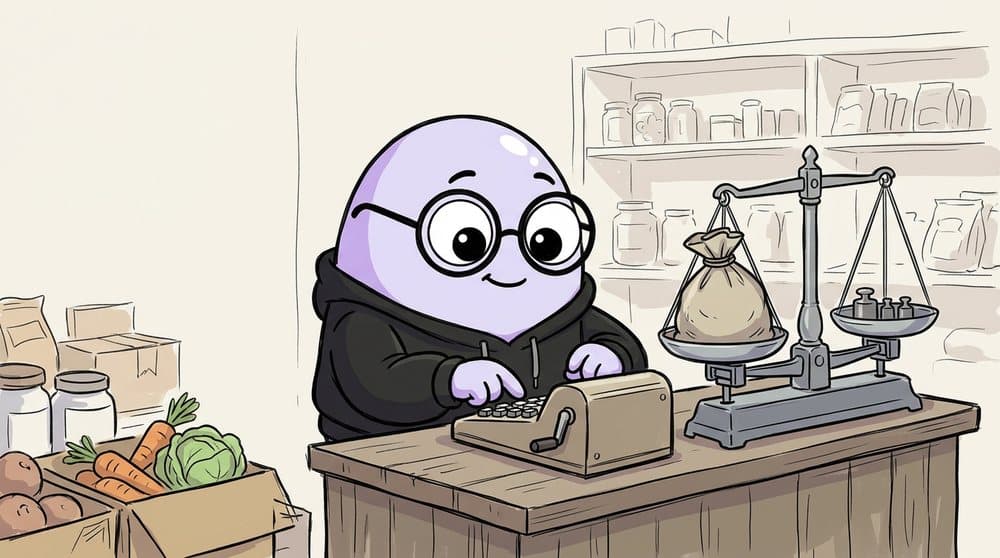
The kirana shop counter
The shopkeeper adds up items, multiplies by quantity, checks "is the total above ₹500 for free delivery?" and decides "cash or UPI?". Arithmetic, comparison, logic and a quick either-or choice: those are exactly Java's arithmetic, relational, logical and ternary operators.
Watch it happen
Evaluating 10 + 7 / 2 * 3 % 4
1/5Multiplication, division and remainder bind tighter than + and -, and run left to right.
The big ideas
What you need to know
Integer division
7 / 2 is 3 when both are ints. Make one side a double, like 7 / 2.0, to get 3.5. % gives the remainder.
Relational operators
==, !=, <, >, <=, >= return booleans. Use == for primitives; use equals() for Strings and objects.
Logical operators
&& (and), || (or), ! (not). && and || short-circuit: the right side is skipped if the left side decides the answer.
Shortcuts
total += price; count++; and the ternary: String fee = age < 12 ? "child" : "adult";
See it in code
Walk through the code
1public class Checkout {2 public static void main(String[] args) {3 int items = 3;4 double pricePerItem = 249.0;5 double subtotal = items * pricePerItem;6 7 boolean isMember = true;8 boolean freeDelivery = subtotal >= 500 || isMember;9 double delivery = freeDelivery ? 0 : 40;10 11 double total = subtotal + delivery;12 total -= isMember ? 50 : 0;13 14 System.out.println("Total: ₹" + total);15 System.out.println("7 / 2 = " + (7 / 2) + ", 7 % 2 = " + (7 % 2));16 }17}1/5int times double gives a double: 747.0.
A checkout with arithmetic, a logical OR, the ternary operator and a compound assignment.
Save yourself the pain
Common mistakes
Oops
double avg = total / count; where both are int.
Do this instead
The division happens in ints first and the decimals are lost. Write (double) total / count.
Oops
if (x = 5) to compare.
Do this instead
= assigns. == compares. Java will not compile if (x = 5) for an int, which saves you here.
Oops
Expecting 0.1 + 0.2 == 0.3 to be true.
Do this instead
Floating-point values are approximations, so it is false. Compare with a small tolerance, or use BigDecimal for money.
Your mission
Canteen bill
Quick check
What does this print: System.out.println(9 / 2 * 2);
Go deeper
- 1Compare 7 / 2, 7 / 2.0 and 7 % 2.
- 2Practise the difference between i++ and ++i in an expression.
- 3Use the ternary operator to pick the larger of two numbers.
More topics at this stop
 Variables & Primitive Data Types
 Type Inference with var
 Type Casting & Promotion
 Strings & String Methods
 StringBuilder
 Reading Input with Scanner

Stuck on this topic? Ask an Insider
Get 1:1 guidance from people who've walked this exact path — on the InsideEdge app.
