In short
Python runs behind web backends, data dashboards, AI models and the little scripts that save people hours every week. It reads almost like English, which is why so many people pick it as their first language and never feel the need to leave.
Python is a general-purpose, high-level programming language known for short, readable code. It is used for web backends, data analysis, machine learning, automation and testing, which makes it a very practical first language.
Think of it like this
The Swiss army knife in your bag
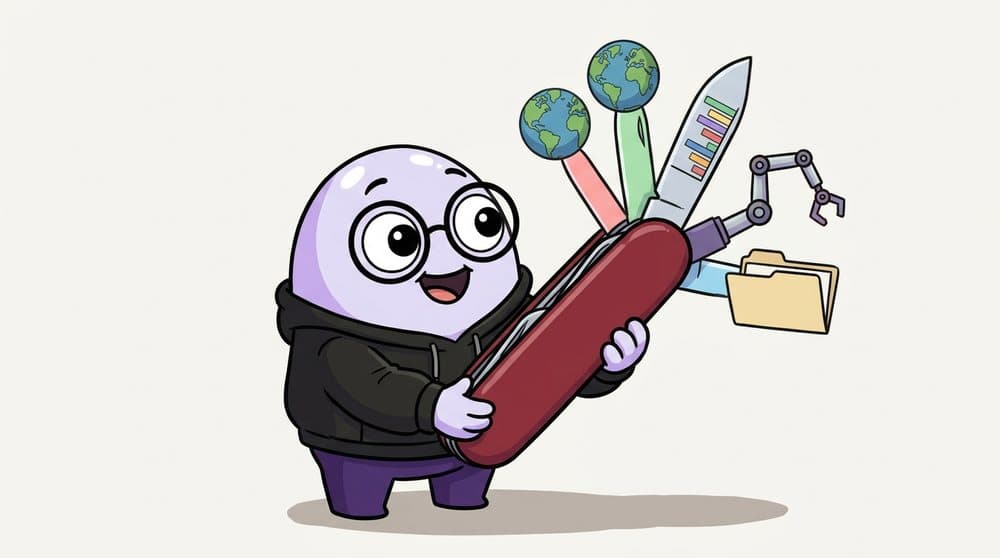
A Swiss army knife is not the fanciest blade or the best screwdriver, but it does a hundred jobs well and fits in your pocket. Python is the same: one language that can build a website, clean an Excel sheet, train a model or rename 500 files, with tools for each job already folded inside.
Watch it happen
Printing an average: Python vs Java
Python
- Three short lines, no class or main method needed
- No type declarations, values decide their own type
- Indentation shows the structure, no curly braces
- Run it directly with python file.py
Java
- Needs a class and a public static void main
- Every variable needs a declared type
- Braces and semicolons on every block and line
- Compile first with javac, then run with java
Both are great languages. Python simply lets a beginner see a result faster and focus on the idea instead of the ceremony.
The big ideas
What you need to know
Readable by design
Python uses plain words like and, or, not, in and is, and indentation instead of braces, so code looks close to the logic you would explain out loud.
High-level and general-purpose
You don't manage memory or worry about the CPU. The same language works for web apps (Django, FastAPI), data (pandas), AI (PyTorch) and automation.
Batteries included
The standard library already handles files, dates, maths, JSON, CSV and web requests, and pip installs over half a million extra packages from PyPI.
Interpreted, so you iterate fast
There is no separate build step for your own code. You save, run, see the result and tweak, which makes learning and experimenting quick.
See it in code
Walk through the code
1marks = [78, 85, 92, 66, 88]2average = sum(marks) / len(marks)3print(f"Average marks: {average:.1f}")4 5if average >= 75:6 print("Distinction! Well done.")7else:8 print("Good effort. Keep going.")1/4A list of five marks. No type declaration, Python works out that this is a list of integers.
A complete Python program. It prints "Average marks: 81.8" and then "Distinction! Well done."
Save yourself the pain
Common mistakes
Oops
Thinking Python is only for AI and data science.
Do this instead
Python is general-purpose. Instagram's backend, YouTube tooling, test automation and countless office scripts are all Python. Pick it for the problem, not the hype.
Oops
Learning Python 2 from an old tutorial.
Do this instead
Python 2 reached end of life in 2020. Always learn Python 3 (3.12 or newer); print("hi") with brackets is the quick giveaway of modern code.
Oops
Believing "easy to read" means "not a serious language".
Do this instead
Readable code is cheaper to maintain. Large companies choose Python exactly because teams can understand each other's code quickly.
Your mission
Spot Python in your day
Quick check
What does Python use to show which lines belong inside an if block?
Go deeper
- 1List three apps or tasks you use daily and guess where Python might be running behind them.
- 2Compare a five-line Python program with the same program in Java or C and notice the difference in length.
- 3Write down which area (web, data, AI or automation) interests you most, so you can choose a path later.
More topics at this stop
 Installing Python & VS Code
 Running Scripts & the Python REPL
 Command Line Basics
 Your First Program with print()
 Comments & PEP 8 Style
 How Python Runs Your Code
 Reading Error Messages & Tracebacks

Stuck on this topic? Ask an Insider
Get 1:1 guidance from people who've walked this exact path — on the InsideEdge app.
