In short
An employees table where each row has a manager_id that points to another employee in the same table. To show 'who reports to whom', the table has to join to itself.
A self join joins a table to itself using two aliases, which is useful for hierarchies like employees and their managers, or comparing rows in the same table.
Think of it like this
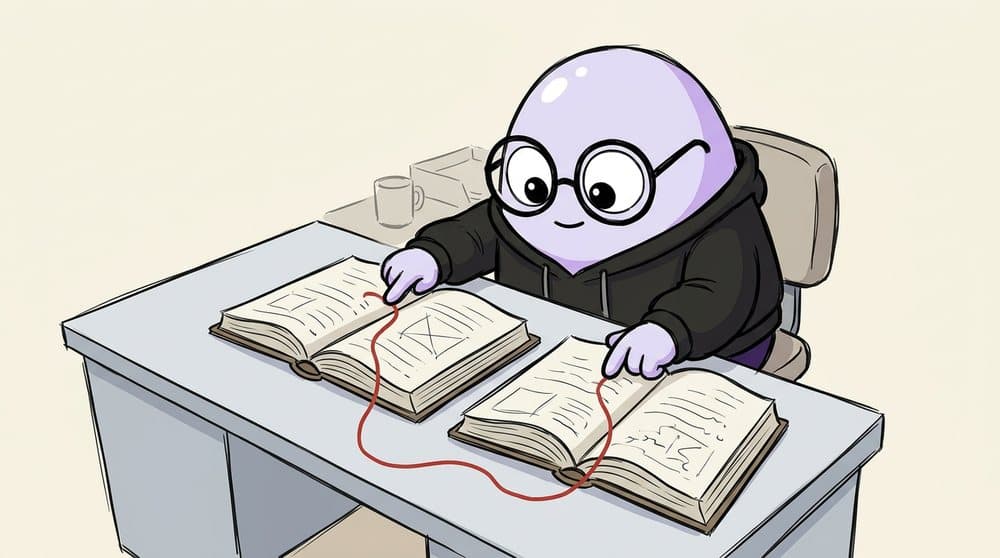
Two photocopies of the staff register
An office in Hyderabad keeps one staff register, and each line says who that person reports to, by staff number. To write the manager's name next to each person, you photocopy the register, lay the copy beside the original, and look up each manager number in the copy. A self join is that photocopy trick, using two aliases for one table.
Watch it happen
Each employee looks up their manager in the same table
1/5One employees table. manager_id points at another row's emp_id.
The big ideas
What you need to know
One table, two aliases
employees AS e and employees AS m are the same table playing two roles.
Perfect for hierarchies
Manager and employee, parent and child category, referrer and referred customer.
LEFT keeps the top
The CEO has no manager. An INNER self join drops her. LEFT JOIN keeps her with NULL.
Comparing rows
Self joins also find pairs, like two customers in the same city. Use a.id < b.id to avoid duplicates.
See it in code
Walk through the code
1SELECT2 e.emp_id,3 e.name AS employee,4 e.designation,5 COALESCE(m.name, '(top of org)') AS manager6FROM employees AS e7LEFT JOIN employees AS m8 ON m.emp_id = e.manager_id9ORDER BY manager, employee;1/3The same table twice: e for the employee, m for the manager.
Every employee next to their manager's name. Works the same in PostgreSQL, MySQL and SQL Server.
Save yourself the pain
Common mistakes
Oops
ON e.emp_id = m.manager_id
Do this instead
That finds each person's reports, not their manager. Read it out loud: the manager's ID equals my manager_id.
Oops
Finding customer pairs in the same city with a.customer_id <> b.customer_id.
Do this instead
You get every pair twice (A-B and B-A). Use a.customer_id < b.customer_id.
Oops
Using an INNER self join for an org chart.
Do this instead
The top person disappears. Use LEFT JOIN so every employee is listed.
Your mission
Org chart in a table
Quick check
Why does a self join need two different aliases?
Go deeper
- 1Show each employee next to their manager's name.
- 2Find pairs of customers who live in the same city.
- 3Use clear aliases like e and m so the query stays readable.
More topics at this stop
 How Joins Work
 INNER JOIN
 LEFT JOIN
 RIGHT JOIN and FULL OUTER JOIN
 CROSS JOIN
 Joining Multiple Tables
 Filtering in ON vs WHERE with Outer Joins
 Anti Joins (Finding Unmatched Rows)
 Duplicate Rows from Joins (Fan-Out)

Stuck on this topic? Ask an Insider
Get 1:1 guidance from people who've walked this exact path — on the InsideEdge app.
