Context Window & Attention
Part of the AI Engineer Roadmap
In short
Paste a 300-page PDF into a chatbot and it may forget page 2. The context window is the hard limit on what the model can 'see', and attention is how it uses that space.
The maximum number of tokens an LLM can 'see' at once — a hard constraint on how much conversation history, document content, or retrieved context you can feed a model.
Think of it like this
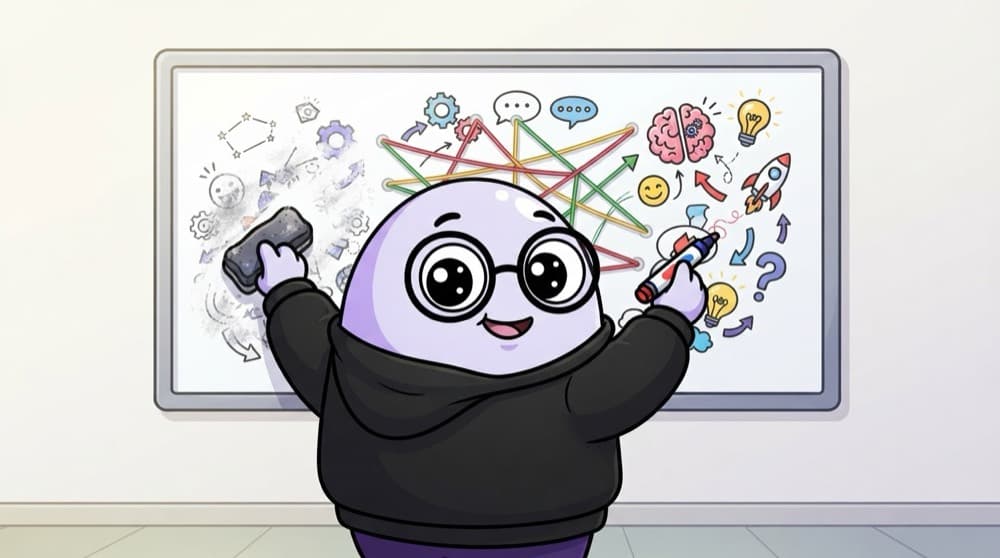
The classroom whiteboard
The teacher's whiteboard has fixed space. When it fills up, the oldest notes get wiped. While explaining, she points back and draws lines between related notes. The board size is the context window. Those connecting lines are attention.
Watch it happen
A chat that outgrows an 8-token window
1/5Toy example: the window fits 8 tokens. Everything the model knows right now must fit here.
The big ideas
What you need to know
Input plus output
The window covers the prompt, the chat history, any documents and the reply. Long answers eat into it too.
Attention links tokens
Each token scores every earlier token and blends in the most relevant ones. That's how 'it' finds what it refers to.
Cost grows fast
Standard attention compares every pair of tokens, so compute grows with the square of length. Long contexts are slower and pricier.
Long isn't always better
Models can miss details buried in the middle of very long inputs. Retrieving the right chunks often beats pasting everything.
See it in code
Walk through the code
1import tiktoken2enc = tiktoken.get_encoding("cl100k_base")3 4def fit_history(system, turns, limit=8000, reserve=1000):5 budget = limit - reserve - len(enc.encode(system))6 kept = []7 for turn in reversed(turns): # newest first8 cost = len(enc.encode(turn["content"]))9 if cost > budget:10 break11 kept.insert(0, turn)12 budget -= cost13 return [{"role": "system", "content": system}] + kept1/3Start from the limit, subtract space for the answer and the system prompt.
Keep the system prompt, reserve room for the reply, and fill the rest with the newest chat turns.
Save yourself the pain
Common mistakes
Oops
Filling the window right up to the limit with input.
Do this instead
Leave room for the reply. If the input uses everything, the answer gets cut off or the call fails.
Oops
Pasting entire books because the model 'supports' a huge context.
Do this instead
Long prompts cost more, run slower and can bury key facts. Send only the relevant parts when you can.
Your mission
Find where it forgets
Quick check
A model has a 16,000-token window. Your prompt is 15,800 tokens. What is the likely problem?
Go deeper
- 1Compare context window sizes across popular models (GPT, Claude, Gemini).
- 2Learn why larger context windows cost more compute (attention scales quadratically with sequence length).
- 3Understand strategies (summarization, retrieval) for working within a limited context window.
More topics at this stop
 LLM Architecture Overview
 Tokenization (BPE, SentencePiece)
 Pretraining vs Fine-tuning
 Popular LLMs (GPT, Claude, Gemini, Llama)
 Open-Source vs Closed-Source Models
 Model Scaling Laws (Overview)
 Emergent Abilities (Overview)
 Multimodal Models (Overview)

Stuck on this topic? Ask an Insider
Get 1:1 guidance from people who've walked this exact path — on the InsideEdge app.
