
Root Cause Analysis (5 Whys, Fishbone)
Part of the Business Analyst Roadmap
In short
Fixing a symptom feels productive, but the problem comes back next month. Root cause analysis keeps asking 'why?' until you reach something that, once fixed, stops the problem for good.
Techniques for digging past a symptom to find the actual underlying cause of a problem — the 5 Whys repeatedly asks 'why' until reaching the root, a Fishbone diagram organizes potential causes by category.
Think of it like this
The leaking ceiling
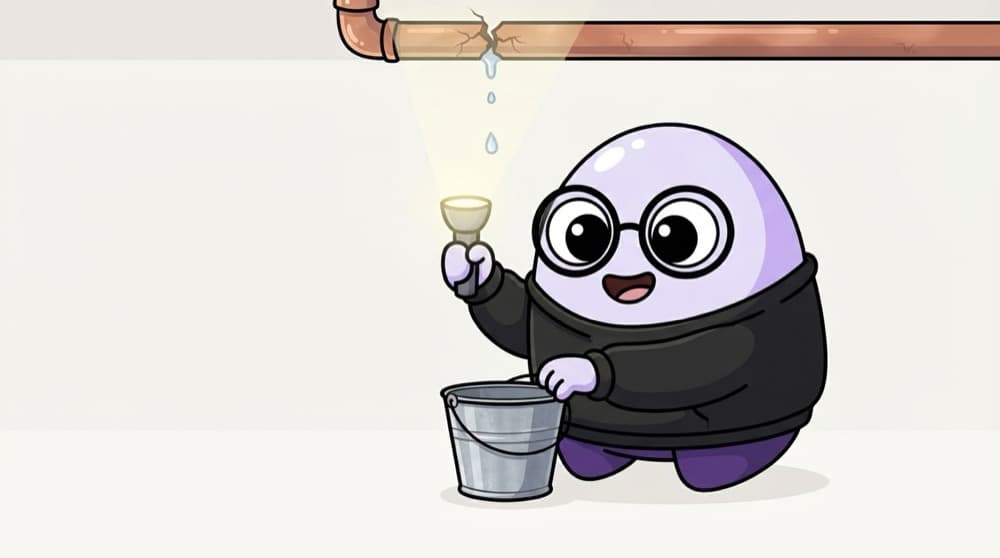
Water drips from the ceiling, so you put a bucket under it. Next day, another bucket. The real fix is going upstairs, finding the cracked pipe and replacing it. The bucket is the symptom fix. The pipe is the root cause.
Watch it happen
A fishbone for 'refunds are late'
1/5Put the problem at the 'head' of the fish. Here: refunds take over a week.
The big ideas
What you need to know
5 Whys
Ask 'why?' about the problem, then about each answer. Around five rounds often reaches a cause you can actually fix.
Fishbone diagram
Also called an Ishikawa diagram. It organises many possible causes into categories so the team doesn't fixate on one.
Check with data
Brainstormed causes are guesses. Confirm which ones actually drive the problem before fixing anything.
Blame the process
If the answer is 'Ravi made a mistake', ask why the process allowed that mistake. Fix the system, not the person.
How it works
5 Whys on the same problem
- 1
Why are refunds late?
Approved refunds wait for the next payment batch.
- 2
Why do they wait?
Payment batches run only on Fridays.
- 3
Why only Fridays?
Finance builds the bank file by hand and has time once a week.
- 4
Why by hand?
The old automatic export broke after a system upgrade.
- 5
Why wasn't it fixed?
Nobody owned it. Root cause: no owner for the bank export. Fix that.
Save yourself the pain
Common mistakes
Oops
Stopping at the first 'why' and fixing that.
Do this instead
Keep going until you reach a cause that, if fixed, would stop the problem coming back.
Oops
Doing root cause analysis alone at your desk.
Do this instead
Do it with people who work in the process. They know causes you'd never guess.
Your mission
Root-cause a real annoyance
Quick check
The 5 Whys ends at 'Because the new clerk made an error'. What's the best next step?
Go deeper
- 1Run a 5 Whys analysis on a real or hypothetical problem you've encountered.
- 2Build a Fishbone diagram categorizing potential causes of a process failure.
- 3Learn why stopping at the first 'why' often just addresses a symptom, not the real cause.
More topics at this stop
 Business Process Modeling Basics
 BPMN (Business Process Model & Notation)
 Process Flowcharts
 As-Is vs To-Be Process Mapping
 Swimlane Diagrams
 Gap Analysis
 Process Improvement Techniques (Lean, Six Sigma Overview)
 Value Stream Mapping

Stuck on this topic? Ask an Insider
Get 1:1 guidance from people who've walked this exact path — on the InsideEdge app.
