
Incident Response in the Cloud
Part of the Cloud Computing Roadmap
In short
At 2 a.m. your bill alert fires: 40 GPU servers you never launched. What you do in the next hour depends on whether you planned it on a calm day.
A structured process for detecting, containing, and recovering from a security incident in cloud infrastructure — including the added step of preserving evidence (logs, snapshots) for investigation.
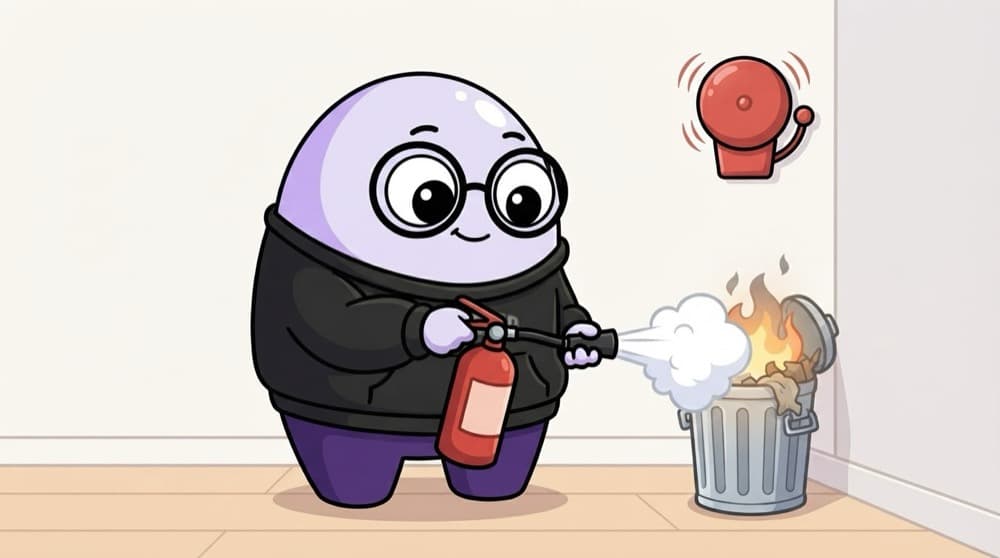
Think of it like this
The school fire drill
In a fire drill nobody debates who carries the register or which staircase to use. It was decided and practised months ago. When the real alarm rings, everyone just follows the plan. Incident response is that drill for your cloud.
Watch it happen
Leaked key: the response plan
1/6GuardDuty or a billing alarm flags strange activity: new instances in a region you never use.
The big ideas
What you need to know
Logs first
Without CloudTrail turned on and kept safe, you can't answer what the attacker did. Enable it before you need it.
Runbooks
Write step-by-step playbooks for common cases: leaked key, public bucket, compromised instance.
Who to call
Know your contacts in advance: team lead, security, and the cloud provider's support. Save the numbers somewhere offline.
Isolate, don't destroy
Move a compromised instance to a quarantine security group instead of terminating it straight away.
See it in code
Walk through the code
1# 1. Contain: disable the leaked key2aws iam update-access-key --user-name ci-bot \3 --access-key-id AKIAEXAMPLEKEY --status Inactive4 5# 2. Preserve: snapshot the suspicious instance's disk6aws ec2 create-snapshot --volume-id vol-0abc123 \7 --description "IR-2026-10-27 evidence"8 9# 3. Isolate: swap to a no-traffic security group10aws ec2 modify-instance-attribute --instance-id i-0def456 \11 --groups sg-quarantine1/3Inactive, not deleted, so you can still see the key ID in logs.
Practise these on your own test account. Real incidents also need your company's process and, often, provider support.
Save yourself the pain
Common mistakes
Oops
Terminating everything suspicious immediately to "make it stop".
Do this instead
Contain first, preserve evidence, then clean up. Deleted instances can't tell you how they got in.
Oops
Writing the response plan during the incident.
Do this instead
Write and rehearse it on a quiet day, even as a 30-minute tabletop exercise with the team.
Your mission
Tabletop drill, solo edition
Quick check
You find an instance mining crypto. What should you do first?
Go deeper
- 1Learn the standard incident response phases: identify, contain, eradicate, recover, review.
- 2Understand why isolating a compromised resource (e.g. removing it from a security group) often comes before full investigation.
- 3Read a public post-mortem of a real cloud security incident to see this process applied.
More topics at this stop
 Identity & Access Management (IAM)
 Principle of Least Privilege
 Multi-Factor Authentication
 Roles vs Users vs Groups
 Encryption at Rest & in Transit
 Secrets Management
 Security Groups vs Network ACLs
 Compliance Basics (SOC 2, ISO 27001)
 Cloud Security Posture Management

Stuck on this topic? Ask an Insider
Get 1:1 guidance from people who've walked this exact path — on the InsideEdge app.
